IndyCar Setups Explained: Why One Car Races Three Different Ways
Welcome to the Happy Hour Racing IndyCar Tech Breakdown - where we take one confusing part of IndyCar and make it make sense. No engineering degree required.

The Short Version
Every team in the NTT INDYCAR SERIES races the same chassis, the Dallara IR-18. But the car that shows up on the streets of Washington, D.C. this Sunday and the car that runs the Indianapolis 500 are barely the same machine. IndyCar allows three aero configurations, and underneath the bodywork teams also change the springs, the ride height, the rear end, the tires and even the brake calipers.
Downforce: The Invisible Weight
Start with the wings. As the car moves, engineers shape the wings and the floor so the air pushes down on the car. That downward push is downforce, basically invisible weight that only exists when the car is moving. More downforce means more grip in the corners. The catch is that everything making downforce also drags on the car and slows it down on the straights.
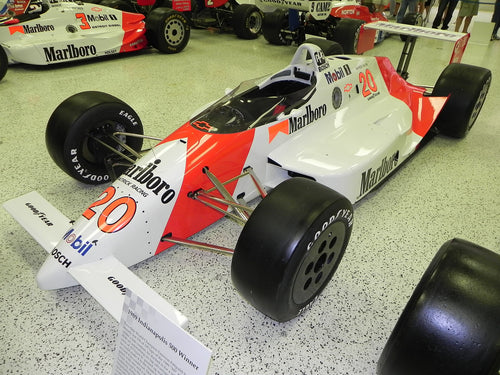
So IndyCar gives teams three shapes, and the track picks the shape. Road and street courses get the maximum: both wings are multi-element, meaning several blades stacked together, plus extra bodywork. Short ovals get a middle setting, still enough to hold the car through the banking but with drag pulled back. Superspeedways, meaning Indianapolis, get almost nothing. The wings are trimmed nearly flat and the bodywork is smoothed out.
The speedway car is even physically shorter, 197.33 inches against 201.7 inches for road, street and short oval work, and the engine gets dialed back with turbo boost capped around 1,300 millibars versus up to 1,500 everywhere else.
The Wings Are Only Half of It
Aero gets the attention, but the work that decides a street race happens at the suspension. Dampers, the shock absorbers, are one of the few areas where teams still develop their own parts, and they matter enormously on broken pavement.
The rule of thumb is simple. Softer springs give you more mechanical grip. A softer car lets the tires stay planted over bumps instead of skipping across them. But a soft car also has to sit higher, because the underfloor is a huge downforce generator and slamming it into a manhole cover at 150 mph costs you the lap and possibly the floor.
Ben Bretzman, who engineers Scott McLaughlin's car at Team Penske, described the tradeoff at St. Petersburg. A smoother street surface lets a team "run a little bit stiffer typically" and lower the ride height, because the floor is "a big downforce generator, keep it close to the ground and try to maximize that as best you can." On a rougher course like Nashville or Toronto, that same team has to back off and build a more compliant car.
That is the real split. A permanent road course is smooth, wide and predictable, so teams chase the lowest, stiffest platform they can get away with. A street course is patched asphalt, storm drains and concrete walls a few feet off the racing line, so the car has to be softer, taller and more forgiving.
The Oval-Only Toolkit
Ovals get parts that never appear on a road or street weekend.
A locked rear end. Road and street cars run an adjustable differential that lets the rear wheels turn at different speeds through a corner. On ovals IndyCar mandates a spool, which locks both rear wheels together. Every corner goes the same direction, so there is no reason to let them spin independently.
Stagger and split compounds. Because the car only ever turns left, teams run larger-diameter tires on the outside than the inside, which helps the car want to turn on its own. Firestone goes further: on ovals the primary left-side tire is a different rubber compound from the right-side, because the right sides carry far more load through the banking.
The weight jacker. This is the fun one. A hydraulic ram sits on the right-rear damper and the driver works it with buttons on the steering wheel. Extending it raises the right-rear corner, which loads up the left-front tire and pulls understeer out of the car. IndyCar limits the travel to half an inch, and drivers adjust it lap by lap as fuel burns off and the track changes. Road and street drivers do not get it.
Smaller brake calipers. Ovals run four-piston calipers, road and street races run six-piston. On an oval a driver barely touches the brake pedal, so there is no point carrying the extra hardware and weight.

Why This Sunday Is the Hard Version
The Freedom 250 Grand Prix of Washington, D.C. runs Sunday, August 23, green flag shortly after 1:00 p.m. ET on FOX. It is a 1.7-mile, seven-turn temporary circuit around the National Mall, the first IndyCar race ever held on the streets of Washington, and it was recently extended by 22 laps to cover a full 250 miles.
Brand-new street circuits are the hardest setup problem in the sport, because nobody has data. Teams lean on the Driver In The Loop simulator, built from laser-scanned road surveys and CAD files of corner radii, curbs and walls. As James Hinchcliffe put it, the simulator is "the best - really, the only - tool you've got" for a track nobody has driven. The limitation is that a scan tells you where the walls are, not how much grip the pavement has or how badly it bumps. Teams will unload with an educated guess and spend practice finding out how wrong it was.
Ready to take on the streets of D.C.
- Team Penske (@Team_Penske) August 18, 2026
What You Will See On Track
Watch the curbs. Drivers ride the curbing hard to straighten a corner, and how well a car absorbs that hit is a direct readout of the damper and spring package. A car that skips sideways off a curb is too stiff for the surface.
Watch the wheel. There is no power steering in an IndyCar, so on a tight street circuit you can see drivers physically wrestling the car, especially late in a stint on worn tires.
Listen for push-to-pass. It only exists on road and street courses, so this weekend it is live. When a driver closes up on the run down Pennsylvania Avenue, that extra shove is legal and limited.
The Bottom Line
IndyCar is a spec series, but "spec" only means everyone starts from the same parts bin. The wings, springs, ride height, rear end, tires and brakes all change depending on whether the car is racing between concrete walls or around a two-and-a-half-mile speedway. When people call IndyCar drivers the most complete racers in the world, this is what they mean: the same field has to be fast in three genuinely different cars.
Rep the series that makes drivers do it all. If this weekend on the streets of D.C. gets you fired up, we have IndyCar gear in stock and ready to ship.