Inside an IndyCar Survival Cell: The Carbon Box Built Never To Break
Welcome to the Happy Hour Racing IndyCar Tech Breakdown - where we take one confusing part of IndyCar and make it make sense. No engineering degree required.

The Short Version
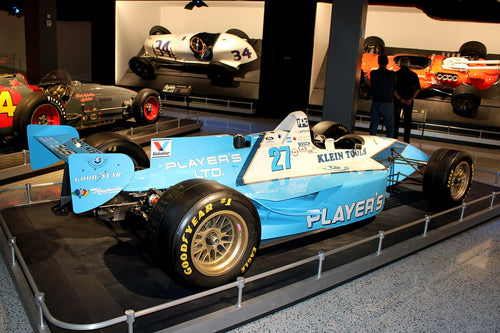
An IndyCar is built around one rigid carbon fiber box called the survival cell, or the tub. The tub is designed to never deform. Everything bolted to the outside of it is designed to be destroyed on purpose, soaking up crash energy before it reaches the driver. Add a bulletproof layer in the sidewalls, a seat molded to one specific human being, and a wall that squashes on impact, and you get the moment fans see every time a car disintegrates on a restart: the driver climbs out and waves.
The Tub: The One Part That Must Not Break
Start with the piece that matters most. The monocoque (say it MON-oh-coke) is a single molded structure that holds the driver and the fuel cell. It is a sandwich: a skin of carbon fiber, a core of aluminum honeycomb, then another carbon skin. That honeycomb layer is the same trick that makes a cardboard box stiff, just in aluminum and at a much higher grade.
Here is the part that surprises people. The IndyCar does not have a frame that the tub bolts into. The tub is the frame. The front suspension and radiators hang off it, and the engine bolts directly to the back of it and becomes a structural member itself. The gearbox bolts to the engine, and the rear crash structure bolts to the gearbox. The car is a chain of parts hanging off one carbon box.
The Crush Zones: Parts Built To Be Destroyed
Bolted to each end of the tub is an attenuator, engineering-speak for a crumple zone. The nose at the front and the structure behind the gearbox at the rear both fold up and absorb energy over a few extra feet, which stretches the crash out over more time. That is the whole game, because the force a driver feels depends on how quickly the car stops, not just how fast it was going.
These are not decorative. Before a nose design is legal it has to survive a double impact test against a solid wall, meaning it gets hit, then hit again, and still has to protect the structure behind it. Along the sides of the tub sit side impact spars, because an open-wheel car that spins into a wall very often arrives sideways. Under the 2026 rulebook, structural repairs to the chassis, nose or attenuator may only be made by Dallara or with Dallara's approval. A team cannot patch a crush structure in its own shop and go racing.

Zylon: The Bulletproof Layer In The Sidewall
Carbon fiber is incredibly strong, but it is brittle. It resists bending beautifully and resists a sharp object punching through it much less well, and in an open-wheel crash that sharp object is very real: a suspension pushrod, a wheel, or a piece of another car's wing arriving at the height of the driver's ribs.
So the sides of the tub get an extra layer of Zylon, a ballistic fiber from the same family of materials used in body armor. Dallara bonds these anti-intrusion panels onto the monocoque in two thicknesses: roughly 12 plies, about 5mm, across the most exposed zone beside the driver, and roughly 7 plies, about 3mm, across the secondary area. Zylon also shows up as the tethers that keep bodywork and suspension pieces attached after a hit instead of flying into the next car.
The Seat Is Built For One Human Being
A driver does not sit in a generic bucket. Under the rules, each seat must be manufactured for a specific driver and carry a tag listing that driver's name, the maker, the build date and an INDYCAR approval sticker. It is molded to that person's spine, wraps as much of them as the cockpit allows, and the driver's side of it must be covered in fire-retardant material.
The belts are six-point harnesses: two over the shoulders, two across the hips and two anti-submarine straps between the legs so the body cannot slide forward and down under the lap belt. The rules even set how deep the driver sits, because the helmet must be a minimum of 7.000 inches below the roll hoop camera mounting face, so the roll hoop and not the helmet is the highest point.
Then there is the detail that tells you how seriously this is taken. IndyCar records the G-forces of every impact, and if a crash registers 65 G or more, the belts are impounded and never used again. The seat gets pulled and inspected too. Equipment that has taken one big hit does not get a second one.
Every driver must also wear INDYCAR-supplied instrumented earpieces. They are not just radio earpieces. Each one carries three accelerometers measuring vertical, lateral and longitudinal force on the head at the moment of impact, which gives the series real numbers on what a driver's head actually did rather than a guess from the chassis sensors. That data is what tells engineers whether a new headrest or harness is genuinely working.
Big thanks to the @indycar aeroscreen yesterday, saved me from a a big one with a pushrod
— Callum Ilott (@callum_ilott) March 20, 2022
The Wall Does Some Of The Work
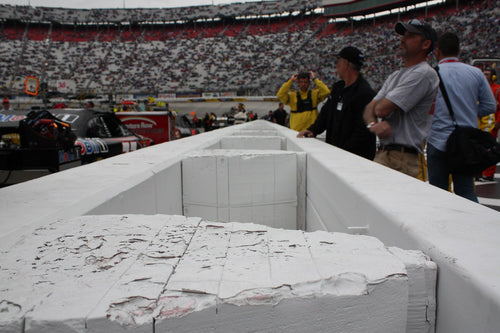
The car is only half the story on an oval. The SAFER barrier (Steel And Foam Energy Reduction) is the wall itself doing some of the absorbing. It is built from five hollow steel tubes, each 8 inches square and 20 feet long, welded into a skin and mounted about 20 inches off the concrete with bundles of closed-cell foam behind it. When a car hits, the steel spreads the load sideways along the barrier and the foam squashes, which lengthens the impact and drops the peak G-force on the driver. INDYCAR and the Indianapolis Motor Speedway funded its development at the University of Nebraska, and the first installation went up at Indianapolis in 2002. Nearly every oval in American racing runs it now.
What Changed For 2026
Two things. All cars at the Indianapolis 500 now run tire-ramp flaps, small hinged carbon panels ahead of the rear tires that pop up when a car is spinning backward and kill the lift that gets a car airborne. It is the same idea as the roof flaps NASCAR has run for years. Second, race control changed its full-course yellow procedure so that whether a pit cycle is underway is no longer a factor in deciding to throw a caution. Driver egress, where the car is sitting and how fast traffic is approaching are.
IndyCar is also honest about what has not worked. The 2012 car carried partial enclosures over the rear wheels meant to stop cars launching off each other. Research found they broke easily and did not reduce big crashes, so they came off in 2018.
What You Will Actually See On Track
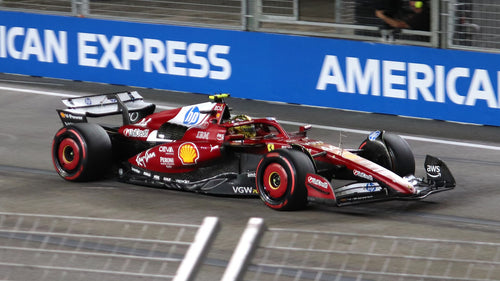
Watch for the fluorescent yellow rear attenuator. That is not a sponsor color, it is the rulebook: rookies must run the back of the crash structure in bright yellow at every event so the field knows who is new. And the next time a car sheds a wing, a nose and a wheel and the driver unbuckles and walks to the ambulance, you are not watching luck. You are watching parts do exactly the job they were designed to do, which was to come apart so the box in the middle did not.
The Bottom Line
One rigid box, surrounded by parts engineered to be sacrificed. The tub does not crush, the ends do, the Zylon stops the debris, the seat and belts are single-use after a big one, and the wall itself gives a little. That is why a 200 mph crash in 2026 usually ends with a driver on his feet.

If you have ever exhaled watching a driver climb out of a wreck, you already get why this sport is worth following. Rep it with something from our IndyCar collection. New tech breakdowns drop every week, so bookmark the blog and never get lost in the jargon again.