Why Your Driver Slows Down to Win: NASCAR Stages and Fuel Windows, Explained
Welcome to the Happy Hour Racing Wednesday Tech Breakdown - where we take one confusing part of NASCAR and make it make sense. No engineering degree required.

The Short Version
Every Cup race is chopped into three stages, and the ends of Stages 1 and 2 hand out bonus points and throw a caution flag. That caution is a free pit stop, so teams build their entire day around it. The catch is that a full tank of fuel only lasts so long, and if the stage runs longer than the tank does, somebody has to either pit under green and lose track position or slow down on purpose to stretch it. That tug-of-war between points, track position, and gallons is what you are actually watching on a Sunday afternoon.
Stages: Three Little Races Inside One Big One
Think of a Cup race like a basketball game with quarters instead of one long clock. Stage 1 and Stage 2 each end at a set lap number. When that lap comes, NASCAR scores the running order right then, throws a caution, and everybody gets a chance to pit while the field circles slowly.
The top 10 cars at each of those two checkpoints collect bonus points: 10 points for first, 9 for second, on down to 1 point for tenth. Those points stick to your season total no matter how the rest of the day goes. So a driver who leads the first half and then blows a tire still walks away with something. That is the entire reason stages exist - NASCAR wanted running up front early to be worth something instead of only the last lap mattering.
The Fuel Window: How Far a Tank Actually Goes
Here is the number that drives everything. The current Cup car carries a spec fuel cell of about 20 gallons - a fuel cell is just a race-legal gas tank, a rubber bladder packed with foam so it does not explode in a wreck. Twenty gallons at Cup Series fuel mileage gets you somewhere in the neighborhood of 40 to 50 laps depending on the track and how hard the driver is running. Teams call that range the fuel window.
Nobody knows the exact number, and that is not an exaggeration. Crew chiefs and engineers estimate it from throttle traces, lap times, and the amount of fuel the can dumped in on the last stop. Longtime NASCAR tech writer Bozi Tatarevic laid out the math fans never see:
The NASCAR Next Gen fuel cell spec is 20 gallons but you can find some that are closer to 21 gallons so let's do some math on how much fuel the 22 needed to save to make it to the end.
— Bozi Tatarevic (@BoziTatarevic) July 1, 2024

Meet the Moves Teams Actually Use
Lift and coast. Instead of staying on the gas all the way to the corner, the driver lifts off the throttle early and lets the car roll in. No fuel is being burned during the coast. Do that every lap and you can stretch a tank several laps further. It is the same reason you get better gas mileage easing up to a red light instead of flooring it and slamming the brakes.
Short-shifting. Upshifting to the next gear earlier than normal, at lower engine speed. Lower RPM means the engine gulps less fuel. You lose a little acceleration and gain a little range.
Riding in the draft. At the big tracks, tucking in behind another car cuts the wind resistance, so the engine works less to hold the same speed. Free mileage, as long as you are willing to run second.
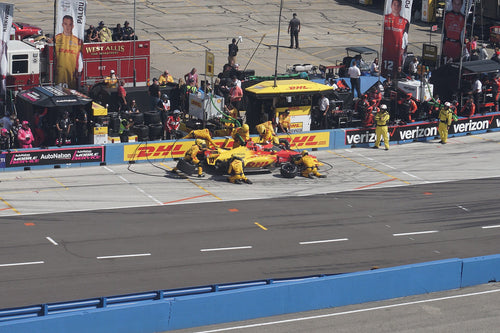
Flipping the stage. This is the sneaky one. A team gives up on stage points entirely, pits two or three laps before the stage ends while the leaders stay out, and then cycles to the front when everyone else pits during the stage caution. You trade a handful of bonus points for clean air and the lead.
What Changed for 2026
Two things reshaped this math for the current season. First, the points. A win is now worth 55 points, with second place back at 35. Stage points did not change, but the gap between winning and running second got enormous, so trading stage points for a shot at the win is an easier decision than it used to be. With the Chase format back and the top 16 in regular-season points making the playoffs, those 10-point stage bonuses still add up over 26 races.
Second, NASCAR started using stage lengths as a tool. Fans complained that superspeedway races had turned into fuel-saving parades, with drivers riding around at partial throttle instead of racing. So for the spring Talladega race, NASCAR flipped the stage lengths on purpose.
Both closing stages now fit comfortably inside the roughly 45-lap fuel window at Talladega. If you cannot gain anything by conserving, the logic goes, you might as well race.
What You Will Actually See on Track
Once you know the fuel window, a lot of confusing television makes sense. A driver who is running eighth and suddenly drops a full second off the pace is not sick, he is saving. A leader who pits with three laps left in a stage is not panicking, he is flipping the stage. When the spotter says the words "we need four more," he means four more laps of coasting before they can go back to racing.
And watch the last 30 laps at any track where the final run is longer than a tank. That is where you see one car sprinting, one car coasting, and the finish coming down to who guessed the mileage right.
The Bottom Line
Stages tell you when the free pit stops are, and the fuel window tells you whether a team can make it there. Every strange call you yell at your TV about is a crew chief answering one question: can we get to the next caution without stopping, and what are we willing to give up if we cannot.

If the pit box is your favorite part of the broadcast, dress like it. The NAPA pit hat is the same style the crew wears over the wall, and you can find every driver we carry in our driver collections. New tech breakdowns drop every Wednesday - bookmark the blog and never get lost in the jargon again.