One Nut Holds the Wheel On: How NASCAR's Single Lug Changed Pit Stops Forever
Welcome to the Happy Hour Racing Wednesday Tech Breakdown - where we take one confusing part of NASCAR and make it make sense. No engineering degree required.

The Short Version
For most of NASCAR history, five lug nuts held each wheel on a Cup car. Since the Next Gen car arrived in 2022, there is exactly one. It sits dead center, it gets cranked down to roughly 450 pound-feet of torque, and it rides to the car inside the pit gun instead of being glued to the wheel. That one change is why a modern four-tire stop can happen in under nine seconds, and it is also why a single mistake now costs a team two laps and two crew members.
Why Five Nuts Became One
The single lug was not really a pit-stop idea. It was a wheel idea. NASCAR wanted the Next Gen car to look like something you could buy, so the old 15-inch steel wheel got replaced by an 18-inch forged aluminum wheel built by BBS. Forged just means the metal is squeezed into shape under enormous pressure instead of poured into a mold, which makes it stronger for its weight.
Here is the problem that created. An 18-inch steel wheel would have weighed close to 40 pounds, versus about 27 for the old 15-inch steel one. That is too heavy to sling around pit road all day. Aluminum solves the weight problem, but aluminum is softer than steel, and it does not forgive sloppy clamping.
Think about tightening the lid on a paint can. If you press down evenly all the way around, it seals. If you mash one side and leave the other loose, the lid warps. Five lug nuts are five chances to get it uneven. NASCAR's own testing found that if lug nuts are left loose, an aluminum wheel loses about 30 percent of its durability. The wheel wobbles a hair, the bolt holes start to deform, and the whole thing gets worse every lap.
John Probst, NASCAR's senior vice president of racing innovation, put it plainly when the change was announced: with the pressure to do a very fast pit stop, he could not say NASCAR ever had proof that all five nuts were fully tight to spec. One nut, right in the middle, squeezes the wheel evenly against the hub every single time. As he summed it up, "The answer became pretty clear that we needed to go single lug nut."
Meet the Parts: The Nut, the Socket and the Gun
The center lug nut is a hardened steel piece with coarse, steeply angled threads. Steep threads mean it travels a long way per turn, so the gun does not have to spin it many times to seat it. Around the outside of the nut are two raised rings with a lip on the inner one. That lip is not decoration - it is a handle.
The socket on the end of the pit gun has spring-loaded fingers that snap onto that lip and hold the nut. That is the part that changed pit road culture. In the old days crews literally glued the five lug nuts to the wheel so the changer did not have to fish them out one at a time. Now the nut rides to the car inside the gun, gets driven onto the hub, and the fingers release. No glue, no juggling.
The gun itself has to do more work than before. One nut carrying the load of five needs a lot more clamping force, which is where that roughly 450 pound-feet figure comes from. For comparison, the lug nuts on your street car are usually somewhere around 100. That is why a changer holds the gun on the hub for about half a second instead of tapping through five nuts in eight tenths to a full second.

Faster, But With a Much Sharper Edge
Do the math on four corners. Saving three or four tenths of a second per wheel adds up, and elite Cup crews now turn four tires and fuel in the neighborhood of nine seconds. That is genuinely fast for a job that involves lifting the car, swapping four tires that weigh roughly 50 pounds each, and dumping fuel.
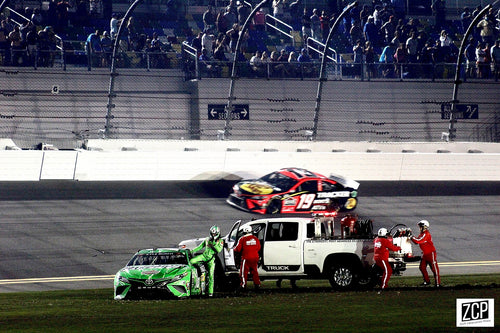
The catch is that there is no backup. Five nuts gave you margin - if one was a little loose, four were still holding. With a single lug, the nut is either seated and torqued or it is not. Cross-thread it, or pull the gun away half a beat early, and the wheel is coming off.
NASCAR treats that as a safety issue, not a bad-luck issue. Under the 2026 rule book, a wheel that separates from the car is covered by Sections 8.8.10.4.A and D, and the punishment is automatic: the two crew members responsible, normally the tire changer for that corner and the jackman, are suspended for the next two Cup points races. It has already bitten real teams this season. Trackhouse Racing lost two crew members after Ross Chastain's right rear came off at Circuit of the Americas in March, and 23XI Racing lost two more after a loose wheel on Bubba Wallace's car at San Diego in June.
A penalty has been issued following this past weekend's action at Circuit of the Americas.
— NASCAR Communications (@NASCAR_Comms) March 3, 2026
Worth knowing: this is a Cup-only design. The Xfinity and Truck cars still run five lug nuts per wheel, and NASCAR rewrote their penalty ladder for 2026. One loose nut out of 20 now costs a team its pit selection for the next race, two brings a fine and a crew suspension, and four gets the car disqualified.
What You Will Actually See on Track
Watch a changer next time the broadcast goes to a pit-road camera. You will see the gun go on and stay on for a beat longer than looks natural. That pause is the torque building. A changer who rushes it is the one you will hear about ten laps later when the spotter says the car feels like it is walking around underneath the driver.
You will also notice how quickly a loose wheel turns into a disaster. There is no wobble-and-limp-to-the-pits phase like there used to be. The car gets a couple of corners, then the wheel is gone and there is a caution. If your driver's team gets caught, remember what it costs them: two people out of the pit box for two weeks, replaced by whoever the team can borrow.
The Bottom Line
NASCAR did not remove four lug nuts to speed up pit stops. It removed them because an aluminum wheel needs one even squeeze instead of five uneven ones. The speed was a bonus, and the pressure came free with it: one nut, one chance, roughly 450 pound-feet, half a second to get it right.

The people who make that half-second happen wear pit crew gear for a living. If you want to dress like the fast side of the wall, we stock real team pit uniform hats along with tees, jackets and hats across the whole garage in our driver collections. New tech breakdowns drop every Wednesday - bookmark the blog and never get lost in the jargon again.