NASCAR Independent Rear Suspension: Why Curb Riding Changed
Welcome to the Happy Hour Racing Wednesday Tech Breakdown, where we take one confusing part of NASCAR and make it make sense. No engineering degree required.

The Short Version
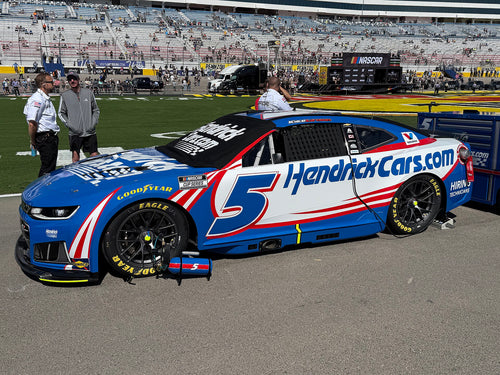
The NASCAR independent rear suspension arrived with the Next Gen car in 2022, and it replaced a rear end that had been in stock cars since the 1960s. Instead of both rear wheels being bolted to one solid axle, each rear wheel now moves on its own. That is why Cup cars finally turn right as well as they turn left. It is also why NASCAR has spent the last few years shaving down curbs at road courses.
What Cup Cars Used Before: A Pickup Truck Rear End
For roughly six decades, a Cup car had a solid rear axle. Picture the back axle of a toy car: one solid bar with a wheel on each end. Both rear wheels were locked to that bar, so they could never move separately.
That axle was held in place by two long steel arms called truck arms, which got their name honestly. The design traces back to 1960s Chevrolet and GMC pickups, and stock car builders borrowed it because it was simple, cheap and almost impossible to break. A bar called the track bar kept the axle from sliding side to side, and crew chiefs adjusted the car by raising or lowering that bar.
It worked for a very long time. It was also a rear end designed to go around in one direction.
What Independent Rear Suspension Actually Means
Independent means exactly what it sounds like. Each rear wheel is attached to the chassis by its own set of arms, its own spring and its own shock. Hit a bump with the left rear and the left rear reacts. The right rear does not care.
With the old solid axle, the two wheels argued with each other. Drop the left rear into a dip and the axle tilts, which tips the right rear too, even though the right rear is sitting on perfectly smooth pavement. Both tires lose a little grip for something only one of them hit.
Meet the Parts at the Back Corner
Each rear corner of a Next Gen car now uses a double wishbone setup. A wishbone is a triangular arm bolted to the chassis at two points and to the wheel hub at one. Stack two of them, one above the other, and the wheel can move straight up and down while staying pointed where the crew chief wants it.
Between the arms sits a coil-over, which is a shock absorber with a spring wrapped around it. Cup teams run five-way adjustable Ohlins TTR dampers, meaning there are five separate knobs an engineer can turn to change how the corner reacts to bumps and weight transfer.

Why NASCAR Made the Switch
Road courses. NASCAR was adding them fast, and the schedule that came together for 2021 brought Circuit of the Americas onto the Cup calendar and put Road America back on it for the first time since 1956. A solid axle built for turning left all day was the wrong tool for a track that turns both ways.
Independent rear suspension lets each rear tire keep its contact patch flat through a corner instead of getting tipped by whatever the other side is doing. That is worth real lap time on a road course, and it is worth something on a bumpy short track too.
The same change also forced a sports-car style gearbox. The Next Gen carries a five-speed Xtrac sequential transaxle at the rear of the car, which we broke down in our transaxle explainer.
What It Changed in the Garage
The track bar went away with the axle it used to locate. That is the single biggest reason the radio sounds different now, and it is the heart of how drivers describe a loose or tight car today.
In its place, teams set the rear of the car with shims, thin metal spacers that change the angles of the wheel. Those angles are camber and toe, which we covered in the alignment breakdown. NASCAR spelled the process out itself:
As the Next Gen car now offers independent suspension in the rear, changes are made in a similar manner in the rear of the car as well.
— NASCAR (@NASCAR) March 24, 2022
Shims are also used to adjust other setup measurements such as toe, which is the angle of the tire relative to the centerline of the car. pic.twitter.com/SJEnzFvgo0
Here is the catch for race day: shims are a garage job. Camber and toe get set before the green flag and stay there. During the race, crews lean on tire pressures and on a weight jacker mounted to the rear dampers that a crew member reaches through the window with a wrench.
So Why Do Curbs Still Beat the Car Up?
Independent suspension helps a tire deal with a bump. It does not make the car soft. Cup cars run stiff, they sit low, and a curb strike sends most of that hit straight through the chassis into the driver.
NASCAR has the receipts on this one, because drivers now wear sensor-equipped mouthpieces. Kyle Larson posted his own data from the bus stop chicane at Watkins Glen:
My mouth piece data from last year through the bus stop. Something needed to be done. What was there before was not safe for the brain. Hopefully this is better. pic.twitter.com/AjpN7unIsb
— Kyle Larson (@KyleLarsonRacin) April 25, 2024
NASCAR confirmed the mouthpiece data from Larson and other drivers showed an abnormally large number of impact incidents in that one section of the track. The tall pyramid rumble strips in the bus stop came out and flat red strips went in.
The Charlotte Roval got the same treatment in 2024. After drivers reported hard jolts to the head in practice and qualifying, NASCAR and Speedway Motorsports pulled the four-inch turtle curbing out of the Turn 16 frontstretch chicane and replaced it with rumble strips 2.25 inches tall.
What You Will See on Track
Watch a road course and you will notice Cup drivers are far more willing to put two wheels over a flat rumble strip than to launch the car over a tall one. Watch a bumpy short track and you will see the rear of the car stay settled over a patch of pavement that used to unload a whole corner.
You will also see teams talk about the rear in terms of angles and shims rather than a bar going up or down. Same goal, different vocabulary.
The Bottom Line
Independent rear suspension gave the Cup car the ability to turn both directions properly for the first time. What it did not give the car was a soft ride, and that is the whole reason curbs keep getting shorter.

Want the car this whole breakdown is about, sitting on your shelf? Start with the Chase Elliott 2022 Next Gen Chevy Camaro 1/24 diecast. If you would rather rep the drivers who have made the most of a car that finally turns right, grab the Shane van Gisbergen 2026 Watkins Glen win tee, the SVG 2025 Charlotte Roval win tee, or the Christopher Bell 2025 COTA win tee. Collectors can also still get the Zane Smith 2022 COTA win 1:24 diecast, and there is only one left. New tech breakdowns drop every Wednesday.