IndyCar Fuel Saving Explained: Why Drivers Lift and Coast
Welcome to the Happy Hour Racing IndyCar Tech Breakdown - where we take one confusing part of IndyCar and make it make sense. No engineering degree required.

The Short Version
Every car in the NTT INDYCAR SERIES carries the same 18.5 gallons of fuel, and no team is allowed a bigger tank. So a race is not just a speed contest, it is a math problem: how far can you stretch one tank, and how much lap time does stretching it cost you. When you hear a spotter say a driver is "saving," it means that driver is deliberately going slower right now to skip a pit stop later. Get the math right and you win from fifth. Get it wrong and you run dry on the last lap.
Everyone Starts With the Same 18.5 Gallons
An IndyCar fuel cell holds 18.5 US gallons. That is it. For comparison, a mid-size SUV holds close to that, and it does not burn through it in twenty-something minutes.
Refueling is refreshingly low-tech. There is no pump. The team keeps its fuel in a tank raised up on a stand behind the pit wall, and when the fueler locks the hose into the car, gravity pushes the fuel down and in. A full 18.5-gallon fill takes roughly seven seconds, which is why an IndyCar pit stop lands where it does on the stopwatch. A good crew can hang four fresh tires faster than the tank fills, so on most stops the fuel hose is the thing deciding when the car leaves.
One quirk of gravity feeding: the fuller the team's pit tank, the faster the fuel flows. Late in a race, with the pit tank down to its last few gallons, the same fill takes a little longer.

What Is Actually in the Tank
Since 2023, IndyCar has run a Shell 100% renewable race fuel. The blend is built mostly on second-generation ethanol made from sugarcane waste out of Brazil, plus other renewable components, and Shell says it cuts greenhouse gas emissions by at least 60% compared with fossil-based gasoline. IndyCar was the first major United States series to switch its whole field to a 100% renewable fuel.
For a fan watching at home, the important part is simple: it is a real racing fuel with real energy in it, and every car gets the same stuff. Nobody is winning a fuel-mileage battle because they bought better gas.
The Two Ways a Driver Saves Fuel
There are only two levers, and drivers use both.
1. The mixture dial. Honda and Chevrolet load a set of engine maps into the car's computer, and the driver picks between them with a dial on the steering wheel. Turn it toward a leaner setting and the engine runs on less fuel per lap. It also makes less power, so the car is slower. Turn it the other way for qualifying or a pass and it drinks more.
2. Lift and coast. This is the one you can actually hear on the broadcast. Instead of staying flat on the throttle right up to the braking marker, the driver lifts off early and lets the car coast for a stretch before hitting the brakes. Every foot of coasting is a foot the engine is not pushing the car, so the fuel number drops. It has a bonus, too: braking later and softer puts less heat and load into the tires.
The hard part is not saving fuel. Anyone can save fuel by driving slowly. The hard part is saving fuel without losing lap time, which is why the great ones stand out here. David Salters, who runs Honda's racing operation in the United States, has put it plainly: anyone can save fuel, but the real challenge is doing it while keeping the car in its fast operating window. Scott Dixon built a career on that skill, and after one of his fuel-stretched runs he gave the credit straight to the engine side, saying the mileage was remarkably easy to get.
The Math That Decides the Whole Race
Here is how a strategist thinks about it. RACER walked through a worked example that shows the shape of the problem perfectly. Flat out, a car might burn about 0.74 gallons per lap. Divide that into 18.5 gallons and you get 25 laps before you are dry. Stretch the same tank to 33 or 34 laps and you need to average about 0.55 gallons per lap instead.
Now weigh it. Every pit stop costs roughly 35 seconds of track time once you add the pit lane and the stop itself. So the two-stop driver banks about 35 free seconds by skipping a stop. The question becomes whether all that lifting and coasting cost less than 35 seconds across the whole race. If it did, the slower-looking car wins. If it did not, the three-stopper drives away.
That is the entire argument you hear on the radio all afternoon.
The Hybrid Gave Drivers Another Lever
The hybrid system added a wrinkle. Drivers now harvest energy with a paddle on the wheel, and spinning up the motor to harvest creates drag that slows the car. On an oval, that means a driver can hold the throttle down in traffic and use the paddle to trim speed instead of lifting. On a road course, drivers can choose to harvest during the coasting phase rather than only under braking. Where you harvest changes how the car feels into the corner and how much fuel the lap takes, so energy management and fuel management are now the same conversation.
What You Will See On Track
Once you know the game, you can spot it from the couch. Watch for a leader whose lap times fall off half a second while nobody catches him: he is saving to make the window. Watch the pit lane on the lap the caution comes out, because a yellow flag hands free fuel to everyone and can instantly erase an hour of careful saving. And watch the overcut, where a driver stays out a lap or two longer than the car ahead and uses clean air to jump it in the pits.
That last one just decided a race. At Portland on August 9, Alex Palou and strategist Barry Wanser left the car out one extra lap in the first stop cycle, and Palou came out ahead of Felix Rosenqvist. He led 60 of the 110 laps, won by 4.1 seconds, and pushed his championship lead to 110 points over Kyle Kirkwood with five races left. No wreck, no last-lap pass, just a better plan with the same 18.5 gallons.
The Bottom Line
Every IndyCar carries the same fuel, so the race is decided by who spends it best. The fastest car does not always win. The car that gets to the end on one fewer stop very often does.
If this is your kind of racing, we have IndyCar gear for it.

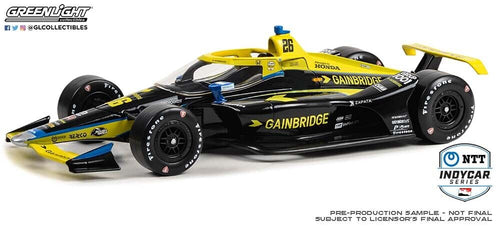
- Colton Herta #26 Gainbridge Andretti 1:18 die-cast - the whole fuel cell and all, shrunk down for the shelf
- 109th Indianapolis 500 Car Flag Tee
- Indianapolis 500 Snake Pit Tee
- IndyCar Checkered Flag Sublimated Tee
- Browse the full IndyCar collection