IndyCar Engines Explained: Chevy vs Honda, 550 to 700 HP
Welcome to the Happy Hour Racing IndyCar Tech Breakdown - where we take one confusing part of IndyCar and make it make sense. No engineering degree required.

The Short Version
IndyCar engines are simpler than most fans think. Every car in the field runs a 2.2-liter twin-turbocharged V6, built by either Chevrolet or Honda, to one shared rulebook. The horsepower number you hear changes from track to track because IndyCar dials the turbo boost up and down - roughly 550 horsepower at the big ovals and around 700 on road and street courses. Teams do not even own these engines. They get them out of a shared pool, and swapping one early can send a car to the back of the grid.
Two Builders, One Rulebook
Chevrolet and Honda are the only two engine manufacturers in the NTT INDYCAR SERIES. Chevrolet's engine is designed and built with Ilmor Engineering. Honda's comes from Honda Racing Corporation USA. They are rivals, but they are not free to build whatever they want.
IndyCar's engine regulations lock down the basics. Maximum displacement is 2.200 liters. Six cylinders, all the same size. Maximum cylinder bore is 95mm. No variable valve timing. No other means of propulsion allowed. Every engine is capped by a series-supplied McLaren electronic control unit at 12,000 rpm, and only 12,200 rpm when a driver hits push to pass.
The result is two engines that are close to identical on paper: about 250 pounds, twin BorgWarner turbochargers, and direct fuel injection. IndyCar even supplies the fuel, an E85 blend of 85 percent ethanol and 15 percent gasoline plus a series additive package, and the rulebook names the only three racing oils an engine is allowed to run.
Why IndyCar Horsepower Changes Track to Track
Here is the part that trips people up. IndyCar does not build a different engine for Indianapolis than it does for Long Beach. It just changes how hard the turbochargers are allowed to squeeze the air going in.
That squeeze is called boost, and it is measured in millibars of pressure inside the plenum, the chamber that feeds the cylinders. More boost means more air, more fuel, and a bigger bang. IndyCar seals its own sensors to the car in two places and lets the ECU police the limit, so nobody can quietly turn it up.
At the superspeedways the limit is 1300 millibars, which puts the engine somewhere around 550 horsepower. Everywhere else it climbs to 1500, worth roughly 700. Push to pass bumps a road-course car to 1650 for a few seconds at a time. The Milwaukee Mile is the odd one out: it is an oval, but it gets the full road-course number, which is why cars look so busy there.
On top of all that sits the hybrid unit, which is shared technology and identical in every car. We broke that down separately in our IndyCar hybrid explainer, and the short version is another 60 horsepower on demand.
Nobody Owns Their Engine

Teams lease their engines. Chevrolet and Honda each present a group of engines to IndyCar called the engine pool, and IndyCar hands them out to cars at random. A team cannot buy a golden motor or hoard a fresh one for the Indy 500. Once an engine goes in a car, it stays in the engine pool until it hits its approved change-out mileage or it fails.
That mileage matters. IndyCar has said a full-season entry gets roughly four engines to cover about 10,000 miles of running across races, team tests and open tests, which works out to a change-out point near 2,500 miles per engine. Pull an engine out before it has earned that mileage and it counts as an unapproved change.
The penalty is real and public. An unapproved engine change costs six grid positions at a road or street course and nine on an oval. If the team, rather than the manufacturer, is the one who called for the swap, the driver and entrant also lose 10 championship points. There is an exception for genuine crash damage, but the team has to show IndyCar the evidence, replace only the damaged parts, and get the repaired engine back.
You saw exactly how this works at the 2026 season finale. Three cars took six-spot hits at Laguna Seca after the Milwaukee doubleheader. Christian Lundgaard qualified fifth in the No. 7 Arrow McLaren Chevrolet and lined up 11th. Marcus Ericsson and Caio Collet got the same treatment.
NEWS: The No. 28 Andretti Global entry has been issued a six-place grid penalty for today's race at WeatherTech Raceway Laguna Seca for an unapproved engine change.
— NTT INDYCAR SERIES (@IndyCar) September 6, 2026
Did the Badge Actually Matter in 2026?
A little. Honda won the 2026 manufacturers' championship, clinching it at the Milwaukee doubleheader before the season reached Laguna Seca. It was Honda's eighth IndyCar Series manufacturers' title and its twelfth in American open-wheel racing, exactly 30 years after its first.
Honda-powered cars won 10 of the 18 races, took 13 poles, and swept all six street-circuit events. Chevrolet won the other eight, including three of the last four. Scott McLaughlin closed the season by putting the No. 3 Team Penske Chevrolet on pole at Laguna Seca by 0.0177 seconds over Alex Palou, a lap that gave Chevrolet its 250th pole position in series history, and then won the race.
What Changes for 2028
This engine formula is in its final stretch. Chevrolet and Honda both signed multiyear commitments announced on February 12, 2026, and each takes a charter starting in 2028. The new power unit that arrives with the next car is a 2.4-liter twin-turbocharged V6 with hybrid technology. We walked through that car in our Dallara IR-28 breakdown.
The Bottom Line
Remember three things and you understand IndyCar engines better than most people in the grandstand. One engine size for everybody, 2.2 liters and twin turbos. The horsepower number moves because IndyCar moves the boost, not because somebody found extra power. And nobody owns their motor, which is why a car that qualified fifth can start eleventh for the crime of changing one too early.
Shop the Story

If you read all the way through the boost table, you are our kind of IndyCar fan. Here is what is in stock right now at Happy Hour Racing:
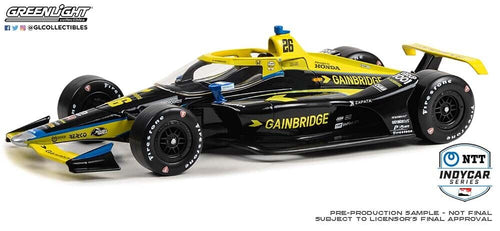
- Colton Herta No. 26 Gainbridge Andretti Autosport 1:18 Scale Diecast
- IndyCar 2025 Checkered Flag Sublimated T-Shirt
- Checkered Flag Sports 109th Indianapolis 500 Car Logo Tee
- 109th Indianapolis 500 In Motion Blue Tee
- Checkered Flag Sports Indianapolis 500 Snake Pit Tee
More IndyCar gear is in the Happy Hour Racing IndyCar collection.