Why IndyCar Has No Power Steering, Traction Control or ABS
Welcome to the Happy Hour Racing IndyCar Tech Breakdown - where we take one confusing part of IndyCar and make it make sense. No engineering degree required.

The Short Version
Your family sedan has power steering, traction control and anti-lock brakes. An IndyCar has none of the three. The car makes more than 700 horsepower and gives the driver a plain rack-and-pinion steering box and two pedals that do exactly what feet tell them to do. That is not an oversight. It is written into the rulebook on purpose, and it is the biggest reason IndyCar looks the way it looks.
No Power Steering Means Exactly That
Power steering is a pump or a motor that helps you turn the wheel. Every road car built in the last 30 years has it. Take it out and you feel every pound the front tires are carrying, straight up the column and into your hands.
IndyCar says it plainly on its own site: the cars do not use power steering, so drivers rely entirely on their own strength and precision. The 2026 rulebook backs that up in the driest way possible. Section 14.9 lists exactly one option for steering: Dallara-supplied rack and pinion parts. No pump. No assist motor. Just gears.
Here is what makes it worse. An IndyCar makes a huge amount of downforce, which is invisible weight that only exists when the car is moving. The faster it goes, the harder the air presses it into the track and the harder the front tires resist being turned. The corners where a driver most wants help are the corners where the wheel fights back hardest.
Alexander Rossi, who came to IndyCar from Formula 1, said the first thing that surprised him was how much more downforce an Indy car makes than an F1 car. He flipped his training from roughly 80 percent cardio in F1 to 60 or 70 percent strength work. On a short oval like Iowa, drivers sit in roughly six times the force of gravity for about half of an 18-second lap, all of it loading one arm and one shoulder.
The Rule That Quietly Bans Traction Control
Traction control is a computer watching your rear wheels. If they spin faster than the car is actually moving, it trims the engine until they hook back up. It saves amateurs from themselves every winter.
IndyCar's ban is not a headline. It is a paragraph. Rule 14.19.7.1 says teams may not use electronic logic processors to control any car function or to interrupt direct input from the driver, except for a short list of INDYCAR-approved control units. That list is four items long: engine, clutch, gearbox and weight jacker. Grip is not on it.
So when a driver gets back on the power out of a slow corner with 700-plus horsepower behind them and a cold rear tire underneath them, nothing steps in. The right foot is the traction control.

No ABS, So Every Braking Zone Is a Bet
Anti-lock brakes pulse the brakes for you when a wheel stops rotating, so you can stand on the pedal and still steer. IndyCar bans that too, and the wording in the brake section of the rulebook is one short sentence: the use of computer logic to control any function of the braking system is not permitted.
What is left is carbon discs, carbon pads and a driver squeezing a pedal hard enough to slow the car at roughly 3.5 to 4G. Push too hard and a front tire stops turning. IndyCar's own glossary has a word for what happens next: a flat spot, the damage you do to a tire by locking the brakes and skidding. That tire vibrates for the rest of the stint or goes in the trash at the next stop.
The only adjustment on offer is brake bias, a knob that shifts braking effort forward or rearward as fuel burns off and tires wear. Turning the knob is allowed. Having a computer turn it is not.
So What Is Actually On the Steering Wheel?
Plenty, just none of it doing the driving. The 2026 rulebook lists the inputs a team must wire through the approved switch board: a neutral button, a reverse button, the overtake button for push to pass, a pit lane speed limiter, weight jacker controls, hybrid deploy and regeneration buttons, shift paddles, clutch paddles, and three rotaries for engine map, engine diagnostics and hybrid regeneration level.
Notice what is missing. There is no grip setting. Every one of those switches asks the car for more of something. None of them protect the driver from what happens next. The wheel itself has become part of the fight, and the newest frame exists mostly to give drivers better leverage.
The NTT IndyCar Series has approved the use of the Cosworth Mk 3 steering wheel for 2025. The optional new model has been chosen by eight of IndyCar's 11 full-time teams and presents drivers with a wider frame to generate more force and leverage. https://t.co/zqEx00mWdX
— RACER (@RACERHQ) December 27, 2024
The One Aid the Hybrid Handed Back
IndyCar did give drivers one thing in 2024. The hybrid unit that debuted at Mid-Ohio can spin the engine's crankshaft, so a driver who spins and stalls can fire the car back up instead of waiting on the safety team. The series keeps it on a short leash: self-starting works on road and street courses, is switched off at ovals, and the system always holds back enough charge for restarts even at zero state of charge. It is a recovery tool, not a performance one.
We covered how the hybrid works and where the 60 horsepower comes from earlier this year.
Will the 2028 Car Change Any of This?
In one place, maybe. The Dallara IR-28 arriving in 2028 does not have power steering at launch, but its steering box is built to accept electric power steering in later test phases. Some drivers want it on safety grounds, since a hard impact through an unassisted rack is what hurts hands and wrists. Traction control and ABS are not on the table. We broke the rest of the new car down in our IR-28 explainer.
What to Watch at Laguna Seca on Sunday
The Grand Prix of Monterey goes green Sunday, September 6 at 2:30 PM ET on the 11-turn WeatherTech Raceway Laguna Seca road course. Two things to watch now that you know the rules.
Corner exits first. Watch the rear of the car twitch when a driver picks up the throttle out of the final corner onto the front straight. That wiggle is a driver catching wheelspin by hand, because nothing else is going to.
Then the heavy braking zones. Look for a puff of smoke off a front tire and a driver instantly easing off. That is a lockup caught before it flat-spots the tire. Catch it half a second late and you are living with the vibration for the next 20 laps.
The Bottom Line
Most modern race cars quietly fix their driver's mistakes. IndyCar decided not to. No power steering, no traction control, no ABS, and a rulebook that names the only four systems a computer is allowed to touch. When you see a driver climb out with taped hands and no voice left, that is not theater. That is the car.

Gear Up for the Grand Prix of Monterey
Season finale weekend deserves better than a blank shirt. Here is what is on the shelf right now at Happy Hour Racing:
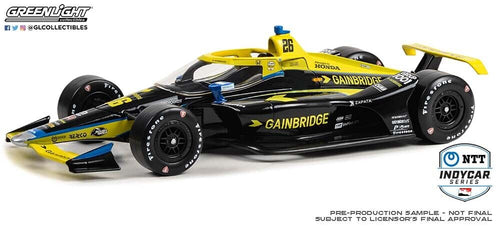
- Colton Herta No. 26 Gainbridge Andretti Autosport 1:18 Diecast - the same car in the Corkscrew photo above, on your shelf.
- IndyCar 2025 Checkered Flag Sublimated T-Shirt - the loudest shirt in the paddock, and we mean that kindly.
- 109th Indianapolis 500 Back Home Again Tee - for the fans who plan the whole year around May.
- Indianapolis 500 Snake Pit Tee - if your race day starts well before the green flag.
- 109th Indianapolis 500 Red Graphic Logo Tee - clean, simple, sized S through 2XL.
Want the whole rack? Browse the IndyCar collection.