Why NASCAR Tires Don't Sit Flat on the Track: Camber, Caster and Toe Explained
Welcome to the Happy Hour Racing Wednesday Tech Breakdown - where we take one confusing part of NASCAR and make it make sense. No engineering degree required.

The Short Version
A NASCAR Cup car's wheels are bolted on crooked, on purpose. Camber is how much the tire leans in or out, caster is how much the steering is tilted back, and toe is whether the tires point slightly at each other or slightly away. Together they decide whether the tire sits flat at the one moment that matters, the middle of the corner. And here is the part most fans never hear: once the race starts, nobody can change any of them.
Camber: Leaning the Tire So It Lands Flat
Camber is the tilt of the wheel when you look at the car head-on. Top leaning away from the car is positive camber. Top leaning in toward the car is negative camber.
Lean hard to your left like you are cutting a corner on a bike. Your feet do not stay flat, the load rolls onto the edges of your shoes. Turn a race car left at speed and the body rolls onto its right side, tipping the right-side tires onto their outside edges.
A tire only grips when the full width of the rubber is on the pavement. So the crew tilts it the opposite way in the garage, betting on how much the car will roll. When it rolls, the tilt cancels out and the tire lands flat. On an oval that means negative camber on the right side and positive camber on the left side, which makes both front tires lean toward the infield.
There is a price, and it is why your driver starts sliding at lap 40. On the straightaway the car is not rolled over, so a tire built to sit flat mid-corner rides on one edge. That edge heats up and gives up first. Road courses flip the math, because the turns go both ways, so teams run negative camber on all four corners.
Caster: The Shopping Cart Trick
Caster is the one nobody can picture, so use a shopping cart. A cart wheel does not sit under its swivel post, it hangs back behind it. That is why the cart tracks straight and why the wheel flips itself around to point forward.
A race car works the same way. The line the front wheel pivots around when you steer is tilted backward at the top, so the tire trails behind it. That tilt is caster. More of it and the wheel fights harder to snap back to center. Less of it and the steering goes light.

Now the clever part. Oval teams put more positive caster in the right front than the left front, and that difference is the caster split. It makes the car want to drift left on its own, so the driver is not arm-wrestling the wheel for 400 laps. Crew chiefs also use the size of that gap to tune how eagerly the car turns in.
Toe: Are the Tires Pointing at Each Other?
Toe is the simplest of the three. Look down from above. Front edges pointing slightly toward each other is toe-in. Pointing slightly apart is toe-out. NASCAR's own explainer calls it the angle of the tire relative to the centerline of the car.
Point your own toes inward and you feel stable but slow to change direction. Point them outward and you can dart sideways. Race cars are the same. Toe-out snaps the car into the corner, toe-in keeps it calm down the backstretch. Get greedy either way and both front tires drag sideways every lap, scrubbing off straightaway speed and cooking the rubber.
Meet the Parts: Shims, Uprights and a Wrench
None of this is a dial in the cockpit. Camber is changed by adding or removing thin metal spacers called shims at the suspension upright, the chunk of aluminum the wheel hub bolts to. Add a shim, the upright sits at a slightly different angle, the tire tilts. Toe works the same way. NASCAR spelled it out itself:
Smaller swings in camber are used as a tuning tool in order to make setup changes to the car in order to optimize performance, and on the Next Gen car those are accomplished by adding or removing shims from the suspension uprights. This is how those pieces look at the front:
— NASCAR (@NASCAR) March 24, 2022
The Next Gen car also brought independent rear suspension, where each rear wheel moves on its own instead of both hanging off one solid axle. That was a first for Cup, and it handed teams real camber and toe adjustment at the back of the car too. Same shims, four corners instead of two.
Why It All Gets Locked In Before the Green Flag
Here is the detail that changes how you watch a race. Camber and toe can only realistically be set before the green flag. Nobody is re-shimming an upright during a 12-second stop. NASCAR has said so directly: once the race is green, teams use tire pressure as the handling tool, because the alignment is already bolted in.
That is why a crew chief asks for a half-pound of air in the right rear instead of a camber change. The guess about track temperature, body roll and tire wear was made in the garage, and the team lives with it for hundreds of laps.
Why This Matters More in 2026
Two changes this season put extra weight on alignment. Cup cars now make about 750 horsepower at every track 1.5 miles and shorter, up from 670, and five tracks - Bristol, Darlington, Dover, Nashville Superspeedway and World Wide Technology Raceway at Gateway - moved to the lower-downforce short-track package.
More power with less aerodynamic grip means the car leans harder on mechanical grip, and mechanical grip is exactly what camber, caster and toe control. When the air is not holding the car down, the contact patch does the work. Nail the alignment and the car still turns at lap 60. Miss it and the right front gives up early.
What You Will Actually See on Track
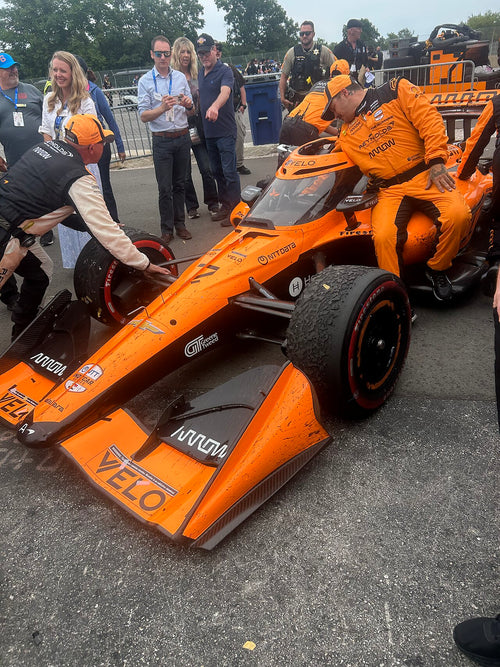
When the broadcast shows a car head-on leaving the garage, look at the front tires leaning toward the infield. That is camber. When a driver says the car will not turn, that is often an alignment guess that did not match the track. And when a crew member drags a hand across a used tire on pit road, they are reading wear: one worn edge points at camber, a feathered ridge across the tread points at toe.
The Bottom Line
Camber leans the tire, caster tilts the steering, toe aims the tire, and all three are locked in before the green flag. Which means a Cup car is never set up for the race it actually runs. It is set up for the race the crew chief thought it was going to be.

If you are the one at the watch party explaining why the right front is giving up, you have earned the hat. Grab the NASCAR logo snapback, or browse the full lineup of driver collections and wear your colors Sunday. New tech breakdowns drop every Wednesday.