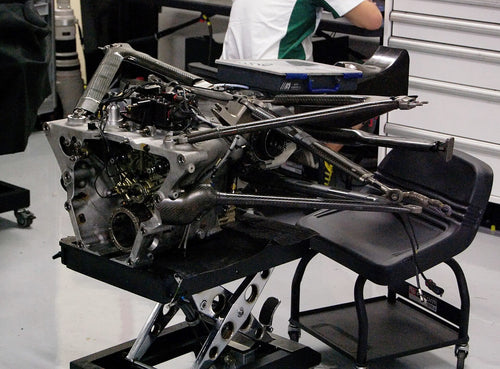
Why Your Driver Gets Loose the Second He Catches Somebody: NASCAR's Underwing, Explained
Welcome to the Happy Hour Racing Wednesday Tech Breakdown - where we take one confusing part of NASCAR and make it make sense. No engineering degree required.

The Short Version
Most of the grip on a Cup car does not come from the spoiler you can see. It comes from a smooth floor called the underwing that runs the whole length of the car and sucks it down onto the track. That suction only works while the floor stays sealed and fed with clean air. Get close behind somebody and the air goes sideways, the floor stops working, and the car turns into something the driver has to wrestle. That is the real reason passing is hard.
The Floor Is the Wing
Here is the part that trips up most fans. On the Next Gen car, the biggest downforce device is the bottom of the car.
Downforce is invisible weight. It only shows up when the car is moving, and it presses the tires into the pavement so they can hold on harder in a corner. At 200 mph a Cup car is making roughly 2,000 pounds of it. That is like setting a side-by-side refrigerator on each corner of the car and having the tires not care.
The old way to make downforce was with bodywork up top. NASCAR went a different direction for the Next Gen car and built one long, smooth floor that runs from the splitter at the front all the way to the diffuser at the back. That floor is the underwing. It is the same floor on all 40 cars, which was the point: nobody gets to go find secret grip in their oil pan anymore.
Meet the Parts
The splitter is the flat blade out front. It decides how much air goes over the car and how much gets shoved underneath. It also seals the front edge of the floor against the track.
The underwing is the floor itself. The gap between it and the pavement is only a few inches. Air forced through a narrow gap has to speed up, and fast air is low-pressure air. Normal air pressure on top of the car then pushes down with nothing pushing back. Same reason a sheet of paper pinned down by a desk fan will not lift off.
The diffuser is the ramp at the back that lets that air expand and leave. It has seven vertical blades called strakes that spin the air up and out so it keeps pulling fresh air through the tunnel behind it. No exit, no suction. The diffuser also carries a safety flap tied to the roof flaps: when a car spins backward, that flap drops about 70 degrees and blocks the tunnel, which raises the speed at which a car can get airborne by 10 to 20 percent.
The spoiler is the only piece of this you can see from the grandstand, and it is the smallest part of the story.

Splitter Stall: The Light Switch Under the Nose
A floor like this does not lose grip a little at a time. It works, and then it quits.
The underwing needs air arriving straight at the splitter at full speed. Take that away and the air under the floor separates from the surface instead of flowing along it, the low pressure fills back in, and the suction disappears. Crew chiefs call that splitter stall. It is closer to a light switch than a dimmer, and that is why drivers describe it as hitting ice at 200 mph. Nothing on the car broke. The floor just stopped being a wing.
Why One Car Gets Tight and the Other Gets Loose
Now put two cars together, and the same mechanism bites both of them in opposite directions.
The car behind is driving through churned-up air the leader left behind. Its splitter is not getting the clean, straight air it needs, so the front of the floor stalls first. Front grip drops, the nose will not turn, and the car pushes up the track. Fans call it an aero push or being aero tight.
The car in front has the opposite problem. The nose of the chasing car pulls air off the leader's rear deck and spoiler, so the back of the leading car loses downforce. The rear tires let go and the leader goes aero loose. That is exactly what a driver means on the radio when he says somebody took the air off him.
What NASCAR Changed, and Why
If the floor is the problem in traffic, the fix is to make the floor matter less. That is most of what the last two years of rules changes have been about.
The short-track and road-course package attacks the underwing directly. It pulls three interior strakes out of the diffuser, shortens the diffuser skirts, and removes the engine panel strakes to keep the front and rear balanced. Air cannot leave as quickly, so the floor cannot pull as hard. Eric Jacuzzi, NASCAR's vice president for vehicle performance, has put that package at about 30 percent less total downforce than the original Next Gen setup. Corner speeds dropped roughly 8 mph in testing, and straightaway speed barely moved.
For 2026, NASCAR bumped power to 750 horsepower at every track 1.5 miles and shorter and moved five more tracks onto that low-downforce kit with its 3-inch spoiler. On superspeedways the trimming kept going: the rear spoiler went from 7 inches to 4 for the August race at Daytona, and NASCAR cut it again to 3.5 inches for the Oct. 25 YellaWood 500 at Talladega.
What You Will Actually See This Weekend
Sunday is the Bank of America Roval 400 at Charlotte, and the Roval runs the low-downforce road-course kit. Watch the car in second place through the infield section. If the nose washes out toward the wall every time it closes to within a car length, that is the splitter starving. Then watch the leader on corner exit. If the back end steps out just as the chaser gets to the bumper, that is the air coming off the spoiler.
Watch the curbs too. Every time a car bangs a curb, the floor lifts and unseals for a moment and the grip goes with it. That is why road-course guys look like they are fighting the car in places where it should be easy.
The Bottom Line
The fastest part of a Cup car is the part nobody in the stands can see. The floor makes the grip, the floor needs clean air, and clean air is the one thing you cannot have while you are trying to pass somebody. Every spoiler cut and every strake NASCAR pulls out is an attempt to make the racing depend less on air and more on the driver.

If you are going to spend Sunday staring at the bottom of these cars, you may as well wear one. The Chase Elliott 2026 Brickyard 400 car scheme tee is in stock, and so is the Kyle Larson 2026 Brickyard 400 car scheme tee. Roval week calls for Roval winners, too: the Shane van Gisbergen 2025 Charlotte Roval winner tee and the Kyle Larson 2024 Charlotte Roval 400 winner tee. The rest of the driver collections are right here.
Want the driver side of the same problem? Read NASCAR loose vs tight, explained. New tech breakdowns drop every Wednesday.