F1 Ground Effect Explained: The Invisible Suction That Sticks the Car to the Track
Welcome to the Happy Hour Racing Formula 1 Tech Breakdown - where we take one confusing part of F1 and make it make sense. No engineering degree required.

The Short Version
An F1 car does not just sit on the track. At speed it is being sucked onto it. The floor of the car is shaped to speed up the air flowing underneath, and fast air is low-pressure air. The normal air pressure above the car then presses it down hard. Engineers call this ground effect, and since 2022 it has been the single biggest source of grip in Formula 1. Here is how a flat-looking floor turns into the most powerful part of the car.
Downforce: Invisible Weight That Appears at Speed
Start with the goal. To go fast through a corner, a car needs grip, and grip comes from pushing the tires into the road. F1 cars create extra push by shaping the car so that moving air presses down on it. That downward push is called downforce - basically invisible weight that only shows up when the car is moving. More downforce means the car can corner harder without sliding. The clever part is where most of that downforce comes from. It is not the wings. It is the floor.
The Venturi Trick: Squeeze the Air, Speed It Up
Here is the one science idea you need, and you already know it. When you put your thumb over the end of a garden hose, the water shoots out faster. Squeeze a flow into a tighter space and it speeds up. Air does the same thing. And there is a second rule that goes with it: fast-moving air has lower pressure than slow-moving air.
The underside of an F1 car uses both rules on purpose. Tunnels molded into the floor pinch the air into a narrow gap in the middle, then open back up at the rear. The air rushes through that pinch, speeds up, and its pressure drops. Now there is low pressure under the car and normal pressure on top. That pressure gap presses the whole car down onto the track. Those shaped tunnels are called venturi tunnels, named after the narrowing-then-widening shape that makes the trick work.
Why the Floor Beats the Wings
A rear wing makes downforce too, but it pays for it with drag - the air it catches also slows the car on the straights. The floor is the efficient option. It makes huge downforce while barely adding drag, because the air is doing its work in the hidden gap under the car instead of slamming into a wing. That is why on a current F1 car roughly 60 percent of the total downforce comes from the floor and the diffuser, not the wings. The wings fine-tune the balance. The floor does the heavy lifting.
Formula 1 leaned into this on purpose. The rules that arrived in 2022 pushed teams to make grip from the floor for a specific reason: a car that gets its downforce from underneath leaves less messy, churned-up air behind it. Less messy air, called dirty air, means the car behind keeps more of its own grip and can follow closely enough to attack. The whole point was better racing and more overtaking.
Next up; the highly innovative floor design
— Formula 1 (@F1) March 16, 2022
Take a closer look into “ground effect”, a revolutionary concept that first emerged in F1 in the mid-to-late 70s #F1
This Is Not New: A Quick History
Ground effect is a comeback story. Lotus figured it out in the late 1970s: the Lotus 78 in 1977 proved the idea, and the Lotus 79 in 1978 won the championship with it. Those cars sealed the floor to the track with sliding skirts so no outside air could sneak in and spoil the low pressure. It worked so well, and pulled such violent cornering forces, that F1 banned it for 1983 and forced cars to run flat bottoms. For nearly 40 years the floors stayed flat. In 2022 F1 brought the tunnels back, just without the dangerous sliding skirts of the old days.
The Catch: Bouncing, or "Porpoising"
Sucking the car down has a downside. The lower the car runs, the stronger the suction gets - right up until the air is squeezed so tight that the flow chokes and stalls. When it stalls, the downforce vanishes in an instant, the car springs back up on its suspension, the airflow reattaches, the suction slams back on, and the car drops again. Repeat that a few times a second and the car bounces down the straight. Fans nicknamed it porpoising, after the way a porpoise rises and dips through water.
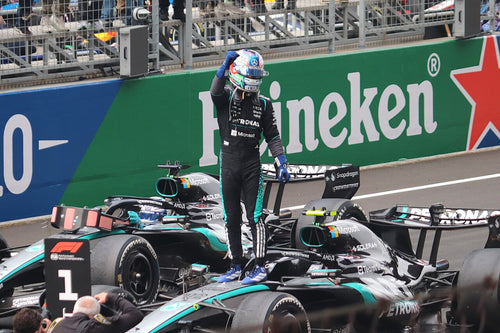
It was brutal in 2022. Mercedes and its W13 got beaten up worst of all, with drivers reporting back pain from the constant hammering at over 160 miles per hour. Teams fixed most of it by raising the car slightly and reshaping the floor, and the FIA stepped in with rules to limit how much bouncing was allowed. This is also why every F1 car carries a wooden-style plank under the floor: worn too thin, it proves the car ran illegally low, which keeps teams from chasing suction all the way into the asphalt.

What Changes in 2026
The current ground-effect era is winding down. The 2026 rules cut the floor back hard: shorter, shallower tunnels and a flatter underbody that gives up roughly 30 percent of the floor's downforce, with overall grip down somewhere in the 15 to 30 percent range. Cars will run a little higher off the ground, which should calm the bouncing and open up more setup options. To replace the lost straight-line efficiency, 2026 adds active aero: wings that flatten out on the straights and stand back up in the corners. F1 is not abandoning the floor, it is just dialing the suction back.
What You Will See on Track
Next time a broadcast shows a car being wheeled through the garage upside down, look at the underside. Those long channels and the ramped section at the back are the whole story of modern F1 grip. And when a driver complains the car is "bottoming out" or bouncing on a fast straight, you now know exactly what is happening: the floor is fighting its own suction. Watch how much closer cars can run in a corner today than they could a decade ago. That is the floor doing its job.
The Bottom Line
Forget the wings for a second. The fastest part of a Formula 1 car is the part you never see. Shape the floor, speed up the air, drop the pressure, and the car glues itself to the track. That is ground effect, and once you know it is there, you will never watch an F1 corner the same way again.

Now that you can read the floor like an engineer, wear the part. Grab the Formula 1 Tech Belgian GP hat, pull on the F1 Tech Collection softshell jacket, or rep your team with a McLaren shadow beanie. Browse the full lineup in our F1 hats collection. New tech breakdowns drop every week - bookmark the blog and never get lost in the jargon again.