IndyCar Red Tires vs Black Tires: Firestone's Primary and Alternate Compounds, Explained
Welcome to the Happy Hour Racing IndyCar Wednesday Tech Breakdown - where we take one confusing part of IndyCar and make it make sense. No engineering degree required.

The Short Version
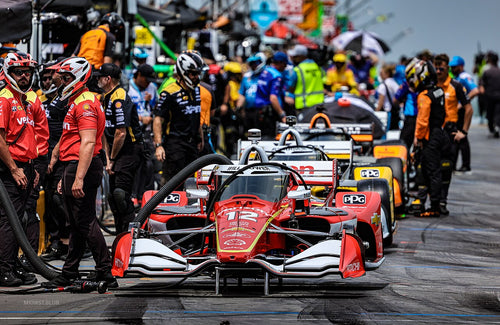
Every IndyCar rides on Firestone tires, and on road and street courses each team gets two dry versions of that tire. The primary has a harder rubber and a plain black sidewall. The alternate has a softer rubber and a red stripe on the sidewall, which is why fans and TV call it the "red." Softer rubber grips better and goes faster, but it wears out sooner. Harder rubber is slower but lasts. That single tradeoff - grip now versus grip later - is the reason tire talk decides so many IndyCar races.
Two Tires, One Big Difference
Both tires are slicks, meaning they have no tread grooves at all. A smooth tire puts the most rubber on the road, and more rubber touching the track means more grip. The only real difference between the primary and the alternate is what the rubber is made of and how it behaves when it heats up.
Think of it like the sole of a shoe. A hard, firm sole lasts for years but slides on a slick floor. A soft, sticky sole grabs everything but wears down fast. Firestone builds the primary like the hard sole and the alternate like the sticky one. Same job, different personality.
What "Softer" Actually Means on Track
When a driver bolts on the reds, the car comes alive right away. The extra grip lets them brake later, turn harder, and get on the throttle sooner. On a qualifying lap, when all that matters is one fast lap, the alternate can be worth a big chunk of time. That is why you see almost the entire field switch to reds when it counts in qualifying.
The catch shows up over a full run. Soft rubber heats up and gives its best grip for a handful of laps, then starts to fade. The tire gets greasy, the car starts sliding, and lap times climb. The harder primary never feels as sharp, but it holds steady lap after lap. So the question every strategist asks is simple: do I want to be fast for a short burst, or steady for a long one.
The Third Tire: Grey Rain Tires
There is one more tire in the truck, and it only comes out when the sky opens up. The rain tire has a grey sidewall and, unlike the slicks, it has deep grooves cut into it. Those grooves are not for grip - they are for moving water. A grooved tire can channel gallons of water per second out from under the car, which keeps the tire touching pavement instead of skiing across the top of a puddle. That skiing feeling is called hydroplaning, and it is exactly what the grooves prevent.

The Rulebook Twist: You Have to Use the Reds
Here is where it gets fun. IndyCar does not just hand teams the tires and walk away. On road and street courses, the rulebook forces drivers to run both dry compounds during a dry race. On a permanent road course, a driver must use at least one set of alternates at some point. On a street course for 2026, the rule got tougher: drivers now have to use two sets of alternates, not one. A set only counts as "used" once the car runs two full laps on it, at least one of them under green.
That rule exists to stop teams from simply picking the best tire and ignoring the other. Since the reds are quick but fragile, and the street version now has to go on the car twice, drivers are forced into a real puzzle: when do you burn your fast-but-fading tires, and when do you ride the steady ones. It even adds a pit stop some teams would rather skip. Longtime IndyCar reporter Bob Pockrass laid out how drivers feel about the change.
Marcus Armstrong doesn't love the new INDYCAR rule that requires drivers to use at least two sets of soft (red-lettered) tires on street courses. We chat about the impact of the rule. Drivers during warmup will try to learn more about the softs today. @IndyCarOnFOX pic.twitter.com/TiuejugWZ5
— Bob Pockrass (@bobpockrass) March 1, 2026
New for 2026: A Return to Red
For a few seasons, some alternate tires wore a green stripe instead of red. That green marked a special sustainable rubber made partly from guayule, a desert shrub Firestone was testing as an alternative to imported natural rubber. For 2026 Firestone folded its sustainable work into a new package it calls ENLITEN, built with materials like soybean oil in place of petroleum and recycled steel in the tire. With that change, the green sidewalls were retired and every alternate went back to a red stripe across the board.
Firestone also spent the offseason reworking the compounds themselves. In 2025 teams complained the reds fell off so fast they treated them like something to throw away as quickly as possible. The 2026 version holds on longer, so a driver can actually race on the reds instead of nursing them. The tradeoff is that the tire now takes a few extra laps to warm up before it gives its best.
Red Tires on an Oval?
For most of IndyCar history the red alternate was a road and street course thing, and ovals ran one single primary tire for everyone. That is changing. Firestone has started bringing a red alternate to select ovals to shake up the strategy, and it did exactly that at Nashville Superspeedway this past weekend, where Alex Palou drove to his fifth win of the season on July 20. Giving oval teams a soft option and a hard option turns a fuel-and-track-position race into a tire puzzle too. It is the same grip-now-or-grip-later choice, just at 180 miles per hour on a banked oval.
What You Will SEE on Track
Now that you know the code, watch for it. A driver who bolts on fresh reds late in a race will look like a rocket for a few laps, carving past cars, then slowly get reeled back in as the tire gives up. A driver stretching a set of primaries will look ordinary early and suddenly strong at the end. When the TV graphic shows a red sidewall, expect an attack. When it shows black, expect patience. And if you spot a red stripe on an oval, know that the strategy just got a lot more interesting.
The Bottom Line
Two tires, one tradeoff: red is fast but fragile, black is steady but slower. IndyCar makes teams use both on road and street courses, which turns every race into a live chess match over grip. Next time a broadcaster says a driver is "on reds," you will know exactly what that means - and why the person on the couch next to you should be paying attention.

Ride with the open-wheel crowd every race weekend. Grab an Indy 500 racing snapback, a race car flag tee, or the Back Home Again tee from our full IndyCar collection. New tech breakdowns drop every Wednesday - bookmark the blog and never get lost in the jargon again.