What "Two Rounds of Wedge" Actually Does: NASCAR's Last Big In-Race Adjustment, Explained
Welcome to the Happy Hour Racing Wednesday Tech Breakdown - where we take one confusing part of NASCAR and make it make sense. No engineering degree required.

The Short Version
Your driver says the car is tight. The crew chief gets on the radio and asks for "two rounds of wedge." He is not changing a spring, a shock or a wing. He is changing how much of the car's weight sits on one diagonal pair of tires. On the current Cup car it is the biggest handling adjustment a team can still make during a race, because the old track bar that crews leaned on for decades does not exist anymore. Here is what one round actually does.
Cross Weight: The Wobbly Kitchen Table
Picture a four-legged kitchen table that rocks. It rocks on a diagonal, because one leg is sitting slightly short. Slide a shim under that short leg and two things happen at once: that leg carries more weight, and so does the leg diagonally across from it. The other two legs carry less. You did not add weight to the table. You just moved which legs hold it up.
A Cup car is that table, with four tires for legs and a driver on top. Teams measure the balance with a number called cross weight, and they usually just call it wedge, or sometimes bite. The math is simple: take the weight sitting on the right-front tire, add the weight sitting on the left-rear tire, and divide by the whole car's weight. Above 50 percent, the car has wedge in it. Below 50 percent, it has reverse wedge.
On an oval, the rule of thumb is short enough to remember: more cross weight generally tightens the car, and less cross weight frees it up.
Tight and Loose, in One Sentence Each
Tight means the front tires give up first. The driver turns the wheel and the nose keeps pushing up toward the wall. Loose means the rear tires give up first and the back of the car tries to come around. Wedge is the dial that slides the car between those two complaints without touching a spring, a shock or a piece of bodywork.
Meet the Weight Jacker
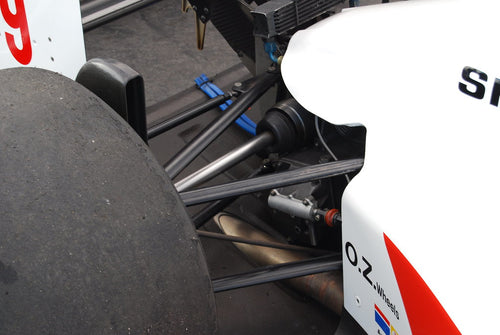
The actual hardware is called a weight jacker, and on today's Cup car it lives on the rear dampers. NASCAR explained it in one sentence when the car debuted: teams adjust crossweight or wedge with a weight jacker installed on the rear dampers, and a crew member reaches through the window with a wrench to do it during a pit stop.
Along with tire pressures, teams can also adjust the balance of the car in the race by changing crossweight or wedge with a weight jacker that can be installed on the rear dampers. The car can be adjusted by a crewmember with a wrench through the window during a pit stop.
— NASCAR (@NASCAR) March 24, 2022
That wrench is the whole story. Turning the adjuster changes how hard that corner's spring is preloaded, which changes the ride height at that corner by a hair, which changes how much load that tire and its diagonal partner are carrying. One full turn of the wrench is one round. "Two rounds" means two turns. That is the entire vocabulary.
Why the Track Bar Is Not an Option Anymore
If you have watched NASCAR for a while, you remember crew chiefs calling for the track bar instead. On the old cars the rear end was a solid axle, a single beam connecting both rear tires, and the track bar was the arm that held that axle in place side to side. Raising or lowering one end of it changed the way the rear of the car leaned in a corner, and it was the fastest way to move the balance. For four seasons starting in 2015 drivers could even reach down and adjust it themselves at speed, until NASCAR took that away in 2019 and sent the adjustment back to the pit stop.
Then the Next Gen car arrived in 2022 and deleted the whole idea. It uses independent rear suspension, meaning each rear wheel moves on its own set of arms instead of being bolted to a shared beam, with five-way adjustable Ohlins dampers at each corner. No solid axle means nothing to hold in place side to side, so there is no track bar on the car at all.
That is why wedge gets talked about so much now. The in-race toolbox came down to three things: tire pressures, tape across the grille, and wedge. Pressure is the fine-tune and it costs nothing, because the air is set behind the wall before the car even arrives. Wedge is the real swing, and it costs time, because somebody has to stop and crank a wrench while four tires are coming off.
Why It Matters More This Season
For 2026 NASCAR turned the power up to 750 horsepower at every track 1.5 miles and shorter, and moved five of them - Bristol, Darlington, Dover, Nashville Superspeedway and World Wide Technology Raceway - onto the low-downforce short-track package with its 3-inch spoiler and fewer diffuser strakes. More power and less aerodynamic grip means the balance of the car wanders further as the track rubbers in, cools off, or picks up a cloud. With fewer tools than crew chiefs used to have, the wrench through the rear window is carrying more of the weekend.

What You Will Actually See on Track
A stop that takes an extra beat. A wedge adjustment is not free. A crew member has to plant the wrench and turn it, and with small over-the-wall crews that costs real time. So when a team takes wedge on a stop, it is because the driver has a genuine problem, not a small itch.
Direction, then a number. On the scanner you will hear a corner and a count: a rear corner named, then one, two, sometimes three rounds. Now you know that is turns of a wrench, not some secret setting.
The next 10 laps. Watch the car that was running the nose up the track in traffic. If the crew chief read it right, the driver starts rotating through the center of the corner again and the lap times come back. If he went too far, that tight car shows up loose off the corner two runs later, and they take some of it back out at the next stop.
A car that changes without changing. Nobody touched the setup sheet, the springs or the aero. The same car can be tight at lap 20 and loose at lap 80 because the track changed underneath it. Wedge is how a team chases that moving target in 10-second windows.
The Bottom Line
A round of wedge does not add grip to a race car. It only decides which two tires carry the load, and on a Sunday where the track bar no longer exists, that one wrench reaching through the rear window is most of what a crew chief has left to fix your driver's day.

If the calls on the box are your favorite part of the broadcast, the Chad Knaus crew chief shirt is for you, and you can rep your own driver from our driver collections any week of the year. New tech breakdowns drop every Wednesday, so bookmark the blog and never get lost in the jargon again.