Why NASCAR Moved the Gearbox to the Back: The Next Gen Transaxle, Explained
Welcome to the Happy Hour Racing Wednesday Tech Breakdown - where we take one confusing part of NASCAR and make it make sense. No engineering degree required.

The Short Version
For decades, a Cup car had a four-speed gearbox bolted right behind the engine and a big hump in the floor next to the driver. The Next Gen car threw that out. Now the gearbox sits at the back of the car, built into the rear axle as one unit called a transaxle. It has five gears instead of four, and the driver shifts it by pulling and pushing one lever instead of moving a stick around an H. That change made the car safer, better balanced, and quicker to shift.
Gears 101: Why a Race Car Needs Them at All
Think about a ten-speed bike. In an easy gear, you pedal fast and go slow, but it's simple to get moving from a stop. In a hard gear, every pedal stroke covers a lot of ground, but you'd never get rolling from a dead stop in it. Gears trade pulling power for speed.
A race engine is the same. It only makes good power in a narrow range of engine speed, measured in RPM (how many times the engine spins per minute). Gears are how the driver keeps the engine in that sweet spot whether the car is doing 45 mph rolling off pit road or 190 mph down the backstretch. First gear is the easy bike gear. Fifth is the hard one.
Transmission vs. Transaxle: It's About Where the Box Lives
Here's the only real vocabulary you need. A transmission is the box of gears. An axle is the assembly that actually turns the wheels. A transaxle is just those two things combined into one unit in one spot.
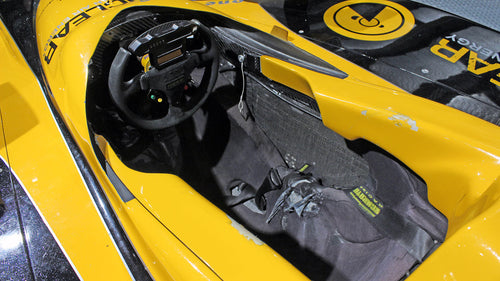
The old Cup car put the transmission up front, right behind the engine, then ran a long spinning shaft back to a separate rear axle. That meant a fat transmission tunnel running down the middle of the car, and the driver had to sit off to the side of it. The Next Gen car keeps the engine up front but sends power straight back through a slim, fast-spinning shaft to the transaxle at the rear. No fat tunnel.
Meet the Part: the Xtrac P1334
Every Cup team runs the exact same gearbox, and it has a name: the Xtrac P1334. Xtrac is a British gearbox company that NASCAR named as the single supplier for the Next Gen car when it debuted in 2022. Nobody gets a better one, because there isn't a better one to buy.
The specs, in plain terms: five forward gears plus reverse, about 172 pounds, and rated to handle up to roughly 553 pound-feet of torque. It also carries a limited-slip differential, which is the part that decides how the two rear tires share the power. When one rear tire starts spinning, a limited-slip sends effort to the tire that still has grip. Teams can adjust how aggressively it does that from outside the gearbox, and that adjustment is one of the quiet ways a crew chief changes how the car drives off the corner.

Why the Shifter Looks Different Now
The old car used an H-pattern shifter, the same layout as a stick-shift street car. You move the lever left, right, up and down to find each gear. It works, but you have to know exactly where you are in the H, and a rushed shift can find the wrong gear.
The Next Gen uses a sequential shifter. Sequential just means "in order." The lever only goes two ways: pull back to shift up a gear, push forward to shift down a gear. One click, one gear, every time. You cannot jump from second to fifth. If you want fifth, you go through third and fourth on the way. Reverse gets its own move - the driver lifts the lever up.
Sequential gearboxes? Fifth gear?
— NASCAR on USA (@NASCARonUSA) January 17, 2020
Take a ride in the NEXT GEN car with @Erik_Jones, via @NASCAR. pic.twitter.com/z9AgT24XaJ
Why This Matters More in 2026
Two things make the gearbox a bigger story this season. First, horsepower went up to 750 at every track 1.5 miles and shorter. More power means more twist arriving at those gears every time a driver stands on the throttle off a corner, and more temptation for the rear tires to break loose. Second, those same short tracks run the low-downforce package, so the car already slides more. The driver is now managing a looser car and a bigger shove, and the gear he picks for the corner is part of how he handles it.
Teams don't get to change the five gears inside the box, so the way they tune for a track is the final drive - the last set of gears in the transaxle. NASCAR approves a specific gearing for each track, and it swings a long way: something around 3.45 to 1 at a superspeedway like Daytona, where cars are pinned flat out, versus something around 6.20 to 1 at a bullring like Martinsville, where they're crawling into the corner and clawing back out. Same gearbox, very different job.
What You Will Actually See on Track
At Daytona and Talladega, you'll basically never see a shift. Cars roll into high gear and stay there. At Martinsville and Bristol, watch the on-board camera and you'll see a driver's right hand snap the lever back and forth every single lap, downshifting into the corner and upshifting off it. At road courses like Sonoma, Watkins Glen and COTA, it's constant - a different gear for nearly every corner, dozens of shifts a lap, hundreds over a race.
And listen for the mistakes. A missed downshift on a restart, or a driver who grabs the wrong gear and bounces the engine off the rev limiter, costs a car length or two instantly. Those car lengths decide short-track races.
The Bottom Line
The transaxle is just the gearbox that moved to the back and learned to count. Five gears instead of four, one lever instead of an H, and all of it sitting between the rear tires so the driver can sit somewhere safer. Next time somebody on the couch asks why the new car sounds different coming off the corner, you've got the answer.

Want the car this whole breakdown is about, sitting on your shelf? The Chase Elliott Next Gen Camaro 1/24 diecast is the real thing in miniature. If you'd rather wear it, we've got the Dale Earnhardt Jr. High Gear tee, plus schedule shirts for the guys who make that gearbox work hardest - road-course ace Shane van Gisbergen and Kyle Larson. Browse the rest of our driver collections and wear your colors at the next watch party. New tech breakdowns drop every Wednesday.