IndyCar Tech Inspection Explained: How Illegal Cars Get Caught
Welcome to the Happy Hour Racing IndyCar Tech Breakdown - where we take one confusing part of IndyCar and make it make sense. No engineering degree required.

The Short Version
IndyCar tech inspection is how officials prove a car is legal, before it qualifies and again after it races. Every team buys the same Dallara parts, so an edge can hide in something as small as a filled seam or the height of one wing endplate. A race result is not official until inspection is done, and that is why a driver can finish second on Sunday and be listed 31st on Monday. Here is what gets checked, how teams get caught, and why one violation costs five points while another costs people their jobs.
What IndyCar Tech Inspection Actually Checks
The rulebook gives officials a lot of room. Rule 14.3 says they decide what gets inspected and in what order, and that it can change by team or by session. They can inspect, impound or confiscate any car, part or piece of data at any point during an event. Teams never know exactly what is coming, which is the idea.
Every measurement starts from one fixed reference. The bottom of the car's skid is zero height, and that reference is set by Dallara and cannot be changed. Think of the door frame where you marked your kid's height. If everybody gets measured against the same frame, the marks mean something.
Weight comes next. Each car has a minimum weight, measured with no fuel in it. Drivers get checked too. Driver plus ballast has to add up to 185 pounds, so a smaller driver gets no free speed. Everyone is reweighed within 15 minutes of the first practice, and breaking the ballast rule can bring a fine of at least $100,000.
Then the paper trail. Teams have to hand over a complete data file from their fastest outing within one hour of first practice, qualifying and final practice. We covered what those files show in our IndyCar telemetry breakdown. Officials can also pull fuel samples before and after a qualifying run and put a seal on any component, the same way every hybrid unit is sealed before it goes in the car.
Before Qualifying: The Line, the Sticker and the Impound
On ovals, cars have to be in the inspection line 30 minutes before qualifying starts. Once a car is in line, the crew can only touch wing angles, endfence angle and tire pressure. The car has to stay as presented for the whole run. At the Indy 500, passing gets you an inspection sticker that clears you to qualify that day.

After qualifying, officials send selected cars to an impound area, and only two crew members per car may go with them. On an oval, a car that fails inspection forfeits its guaranteed qualifying attempt and goes to the back of the lineup.
The Part That Started It All: Penske's Attenuator
The biggest inspection story in recent IndyCar history came at the 2025 Indy 500. The attenuator is the crash structure on the back of the car, part of the system we explained in our survival cell breakdown. It is a spec part, and teams may not modify it. Team Penske filled a seam next to it, closing off airflow, apparently to cut drag and gain straight-line speed.
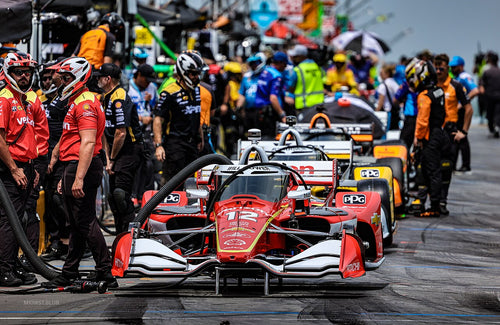
Rival teams noticed during qualifying, and Chip Ganassi was among those complaining. Josef Newgarden's and Will Power's cars were pulled back to the garage. People were watching pit road in real time:
Pointed out by @RacingNationTV , the No.12 crew are working on the rear wing of the car, seems to be that they’re switching out assembly’s? #Indy500 #INDYCAR pic.twitter.com/FtSHFifmhs
- Austin Lawton (@austinlawton_) May 18, 2025
Both cars ended up at the rear of the field. Each entry was fined $100,000 and their strategists were suspended. Three days after qualifying, Team Penske fired Tim Cindric, Ron Ruzewski and Kyle Moyer. It came a year after the push to pass scandal.
After the Race: Why IndyCar Results Stay Unofficial
IndyCar posts unofficial results first and official results only after review and tech are finished. Passing earlier is no protection either. Rule 14.3 says a penalty can still come even if the car or part cleared inspection before, because staying legal is the team's job all weekend.
That same 2025 race proved it. Marcus Ericsson finished second and dropped to 31st after post-race inspection found unapproved spacers and parts around the bodywork covers on his Andretti car. Teammate Kyle Kirkwood and Prema's Callum Ilott were hit too, with $100,000 fines per entry and team managers suspended for the next race.
Same Wing, Very Different Penalty
Now look at Alex Palou. After the 2026 Indy 500, his No. 10 Ganassi Honda failed the front wing check. The rule says that wing cannot measure less than 8.300 inches on the inspection fixture. Officials called it an assembly error and "not an intentional change." The penalty was five driver points, five entrant points and a $10,000 fine.
Ilott's car also failed on front wing endplate height a year earlier, and he went from 12th to 33rd with a $100,000 fine. His case also carried an improper conduct finding, while Palou's was ruled an honest assembly mistake. It is not just what failed. It is what officials decide happened.
Who Runs IndyCar Tech Inspection Now
Because Roger Penske's company owns the series, the 2025 scandal raised an obvious question about who polices whom. The answer arrived in December 2025. INDYCAR Officiating is a new not-for-profit overseen by a three-person board: Ray Evernham, Raj Nair and FIA appointee Ronan Morgan. Its managing director reports to that board with no oversight from INDYCAR or Penske Entertainment officials, though reports say Penske Entertainment still funds the officials.
Longtime technical director Kevin Blanch stepped away in June 2026, and Nick Allen took over. Inspection findings now get posted on a public noticeboard, starting with the June race at World Wide Technology Raceway. The next step is laser scanning. After Portland in 2025, four cars were sealed and sent to Dallara for 3D scans, and all four came back legal. IndyCar president Doug Boles wants scanning as standard equipment ahead of the new car in 2028.
The Bottom Line
Tech inspection is not one test. It is a weekend-long checklist where passing on Friday protects nothing on Sunday. So the next time an IndyCar result changes after the checkered flag, ask one question: was it a mistake, or was it a modification? That answer is the difference between a $10,000 fine and a team's front office getting fired.

The 109th Indy 500 is the race that changed how IndyCar polices itself, and you can wear it. Start with the 109th Indy 500 Car Logo Tee, or grab the Back Home Again Tee, the Snake Pit Tee or the Checkered Flag Sublimated Tee. The full rack lives in our IndyCar collection, and a new Tech Breakdown drops every Wednesday.