F1 Flexi-Wings Explained: The Bend the FIA Hunts All Season
Welcome to the Happy Hour Racing Formula 1 Tech Breakdown - where we take one confusing part of Formula 1 and make it make sense. No engineering degree required.

The Short Version
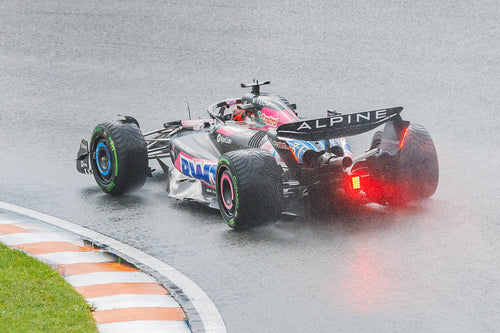
A Formula 1 wing is supposed to be stiff. Teams would rather it was not. A wing that quietly bends flatter at 200 mph sheds drag down the straight and springs back for the corner, which is free lap time out of a part that never officially moves. The FIA cannot put a ruler on a car at racing speed, so it hangs weights on the wing in the garage and measures the sag, then films the same wing on track using painted dots. For 2026 that whole test list got rewritten, because now the wings are supposed to move.
Why a Bending Wing Is Worth Real Money
Every wing on a race car does two things at once, and they fight each other. It pushes the car down into the road, which is downforce, and it drags the car backwards through the air, which is drag. A steeper wing gives more of both, a flatter wing gives less of both, and engineers must pick one compromise for the whole lap. Steep enough for the corners means slow on the straight.
Carbon fibre offers a loophole. Carbon is stiff, but nothing is perfectly stiff, and the air load on a wing grows roughly with the square of the speed. Double the speed and you roughly quadruple the load. So a wing that looks rock solid in the garage can sit noticeably flatter at the end of a long straight, then relax back into shape the moment the driver brakes. Engineers call that aeroelasticity. Fans call it a flexi-wing. Either way nothing was commanded to move and no motor was involved, which is exactly what makes it so hard to police.
The Rule Is Short and Deliberately Broad
Article C3.18.1 of the 2026 Formula 1 Technical Regulations opens by saying that any bodywork put through these tests must be "of rigid construction". The next sentence is the one teams actually worry about: any system, mechanism or procedure that achieves, seeks to, or is suspected of circumventing the tests is prohibited. The FIA then reserves the right to add new tests, change existing ones, or demand more evidence from a team for any bodywork that appears to be moving on track.
Read that again, because it is unusual. Passing today's test is no defence if the FIA decides to write a different test next month. That is the stick behind every flexi-wing story you have ever read.

How the FIA Actually Measures a Wing
The process is far less futuristic than you would expect. A scrutineer wheels a rig up to the car, presses a known load onto a known point, and reads how far the part moved. These are the 2026 numbers:
- Front wing body: 1,000 newtons, roughly 225 pounds, pushed straight down on each side. Loaded on both sides at once, the wing may sag no more than 15mm. Loaded on one side only, no more than 20mm.
- Front wing flap: a 60 newton point load, about 13 pounds, through a 25mm rubber pad on the trailing edge. Limit 10mm, and the flap must be sitting in its Corner Mode position when they do it.
- Rear wing: two loads applied together, about 985 newtons downward and 218 newtons rearward per side. The wing may move no more than 6mm and may twist no more than 1.0 degree.
- Rear mainplane trailing edge: 200 newtons, maximum 3mm.
- The carbon skin itself: a 50mm vacuum cup pulls on the surface with 60 newtons, and the skin may lift no more than 2mm.
Those Painted Dots Are Not Decoration
A garage test cannot see 200 mph, and the FIA knows it. Article C3.18.15 lets the governing body order teams to stick contrasting markers onto the bodywork and to carry extra FIA cameras in free practice. Scrutineers then film the wing at speed and track how far each dot drifts. If you have ever watched an onboard and noticed little coloured spots on a front wing endplate, that is a legality check, not sponsorship.
That camera programme is what produced the famous clampdowns. The FIA started filming wings in 2024, and in 2025 the limits came down twice. Technical directive TD055A landed the day after the Australian Grand Prix and cut the permitted rear wing slot gap movement from 2mm to 0.75mm for China, then to 0.5mm from Japan. From the Spanish Grand Prix the front wing tests tightened too, with the symmetric limit going from 15mm to 10mm.
There are plenty of aerodynamic talking points within our 2026 technical regulation changes, none more so than the wings...
- Formula 1 (@F1) January 9, 2026
2026 Changed the Question Entirely
Here is the twist. Under the 2026 rules the wings are meant to move. Both ends of the car now switch between a high-downforce Corner Mode and a low-drag Straight Mode, driven by up to two actuators at the front and one at the rear, with position sensors wired straight into the FIA Standard ECU.
So the rulebook stopped asking only "did it bend" and started asking "did it go exactly where it was told, and come back exactly where it started". The wing has to complete the switch in no more than 400 milliseconds. The Corner Mode position has to be identical after every single Straight Mode operation. If the system fails, it must fail back to Corner Mode, and physical stops have to prevent the flaps rotating anywhere they should not go. That is also why the flap flex test is now specified to be run with the flap parked in Corner Mode.
The 2026 Case Study: the Wing That Would Not Shut
It took one race weekend for all of this to get tested in public. At the Chinese Grand Prix in March, onboard footage of Kimi Antonelli's Mercedes showed the front wing closing in two separate stages rather than one clean movement. A rival team asked the FIA for clarification, and the paddock started asking whether Mercedes had found a way around the 400 millisecond sensor check.
The answer was far less exotic. Mercedes had underestimated how much hydraulic pressure it takes to force the wing back into Corner Mode against the air at top speed, so the element only finished closing once the car slowed. The team spotted it in qualifying, could not cure it for the race, and fixed it at Brackley before Suzuka. The FIA accepted the explanation, partly because the fault was costing Mercedes balance on corner entry rather than gaining it anything. FIA single-seater director Nikolas Tombazis summed up the approach: "When it comes to minor inconsistencies, we don't immediately send orders to the stewards." No penalty, no technical directive.
What You Will Actually See on Track
Watch the onboard camera on a long straight. The front flaps flatten and the rear flap drops open as the car commits to Straight Mode, then everything snaps back the instant the driver lifts for the braking zone. Look for small reference dots near the endplates on whichever cars the FIA picked that weekend. And when a car looks unusually quick on the straight while still carrying corner speed, expect rivals to be filming its wing by Saturday morning.
The Bottom Line
A race wing is a compromise between corner grip and straight-line speed, and teams have spent 20 years trying to cheat that compromise with carbon that bends. In 2026 the bending is finally legal, but only on command, only through a sensor, and only within four tenths of a second. The FIA still turns up with a 1,000 newton weight and a dial gauge, because the only flex it trusts is the flex it can measure.

If you are the one at the watch party explaining what a slot gap is, you have earned the hat. Start with the Formula 1 Tech Limited Edition Belgian GP Hat, then pick your side: McLaren New Era 9Fifty, Mercedes-AMG Petronas ball cap, Scuderia Ferrari garage crew tee, or the Red Bull Racing USA GP tee. The full rack lives in our Formula 1 collection, and a new Tech Breakdown drops every Wednesday.