NASCAR Overtime Rule Explained: Why Races Run Long
Welcome to the Happy Hour Racing Wednesday Tech Breakdown - where we take one confusing part of NASCAR and make it make sense. No rulebook required.

The Short Version
The NASCAR overtime rule exists so races end under green, not behind the pace car. If a caution flies near the end, the race gets extended for a two-lap dash: green flag, white flag, checkered flag. If another wreck happens before the leader takes the white flag, NASCAR resets and tries again, with no limit on attempts. In 2026, 7 of the 36 Cup points races ran past their scheduled distance, including Ty Gibbs' first career win and Ryan Preece's first career win.
Why NASCAR Hates Finishing Under Yellow
Picture a basketball game where the last two minutes get played with the clock stopped and nobody allowed to shoot. That is what a caution finish feels like. The pace car is out, the field is frozen, and whoever happened to be in front when the yellow came out wins without a fight.
Fans hated that, and so did NASCAR. So the sport built a rule that keeps a race alive past its scheduled distance until it can end with drivers actually racing. That is overtime. A 400-mile race might become 410 miles. Nobody gets refunds for the extra laps, and nobody complains about them either.
How the NASCAR Overtime Rule Works, Step by Step
Here is the sequence when a caution comes out late and there are not enough laps left to restart and finish normally:
- The field runs caution laps. Cars pit, the wreck gets cleaned up, and the laps under yellow still count. That is why the final lap count can jump by several laps.
- Green flag. The field restarts. This is the first lap of the overtime attempt.
- The overtime line. Today, that line is the start-finish line. If the leader gets back to it under green, the leader takes the white flag and the attempt is official.
- If the caution flies before that, the attempt does not count. Back to the pace car, clean up, and try again.
- If the caution flies after the white, the race is over. NASCAR freezes the running order at the moment the yellow comes out, using its scoring loops and video, and whoever is in front wins.
How We Got Here: From One Try to Unlimited
This rule has been rewritten more than almost any other in the sport:
- 2004: NASCAR adds the green-white-checkered finish, with one attempt. If that failed, the race ended under yellow.
- 2010: NASCAR allows up to three attempts.
- 2016: The three-try cap goes away and the "overtime line" arrives. Its spot varied by track and was usually on the backstretch. If the leader got past it before a caution, the attempt counted. Attempts became unlimited.
- August 2, 2017: After a season and a half of complaints, NASCAR moved the overtime line to the start-finish line, starting that week at Watkins Glen. NASCAR executive Steve O'Donnell said the change would "benefit the race."
The backstretch line had a real problem. A race could become official on a part of the track where most tracks have no grandstands, and a wreck a few hundred feet later still ended it under yellow. Moving the line to the stripe made the rule simple enough to follow from your couch: if you see the white flag, the next flag ends it.
Overtime in 2026: Seven Races and Two First-Time Winners
According to NASCAR's official race data, seven of the 36 Cup points races this year ran past their scheduled lap count. That is roughly one in five. Kyle Larson and Tyler Reddick each won two of them.
Bristol, April 12. The yellow flew on lap 498 of 500 and set up the first overtime restart at Bristol in 11 years, according to the Associated Press. Ty Gibbs held off Ryan Blaney by 0.055 seconds for his first Cup win, in his 131st start. NASCAR called it the closest finish at Bristol since 1991. Without overtime, that race ends under yellow and Gibbs' first win looks a lot different.
Daytona, August 29. This one shows the other half of the rule. A lap 155 crash sent the regular-season finale to overtime. On the final lap, Zane Smith got turned while blocking Tyler Reddick, and the caution came out. Because the field had already taken the white flag, there was no reset. The running order froze, Ryan Preece was in front, and he had his first career Cup win and the last spot in The Chase.
RYAN PREECE IS A NASCAR CUP SERIES WINNER. pic.twitter.com/e1SjHoVH1N
- NASCAR (@NASCAR) August 30, 2026
What to Watch for at the End of a Race

Next season, when a caution comes out in the last few laps, watch the flag stand. Before the white flag, every wreck means another restart, and drivers know it, so they take wild chances on the restart lap. Once the white flag is out, the math flips. The leader just has to survive one lap, and the cars behind know that a wreck anywhere on the track ends the race right where it stands.
That is also why you see so many crashes on overtime restarts. The field is bunched up on fresh tires, everybody is within a few car lengths of the win, and there are only two laps to make something happen. Add the bumping and pushing of drafting at Daytona and Talladega, and one restart can collect half the field.
One more thing: overtime is not the same as a stage break. Stages end at a set lap no matter what, which we covered in our stages and fuel windows breakdown. Overtime only applies at the very end of the race.
The Bottom Line
The NASCAR overtime rule comes down to one flag. Before the white, a wreck means try again. After the white, a wreck means it is over.

If you stay on the couch until the very last flag, you are our kind of fan. Browse our driver collections, and check the Cup schedule and standings for when the green drops on 2027. New tech breakdowns drop every Wednesday.
Gear from this year's overtime finishes:
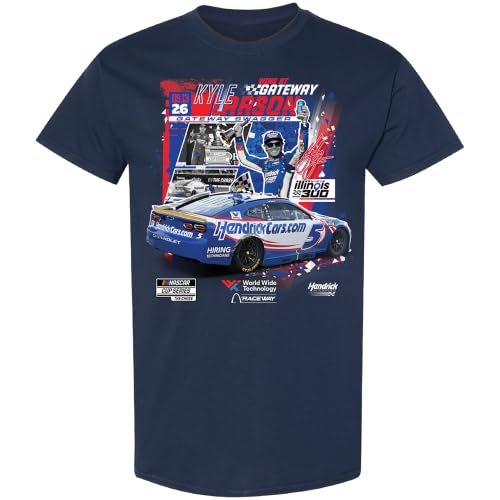
- Kyle Larson #5 2026 Enjoy Illinois 300 Win T-Shirt - Gateway went seven laps long, and the champ still closed it out. The featured pick above.
- Ryan Blaney #12 2026 Quaker State 400 Atlanta Win T-Shirt - an overtime win by 0.068 seconds.
- Ty Gibbs #54 2026 Iowa Corn 350 Win T-Shirt - Gibbs' second win of the year, four months after his overtime breakthrough at Bristol.
- Kyle Larson #5 2026 Cup Series Race Schedule T-Shirt - all 36 races on the back, overtime included.