IndyCar Cooling Explained: Why Teams Block Their Own Radiators
Welcome to the Happy Hour Racing IndyCar Tech Breakdown - where we take one confusing part of IndyCar and make it make sense. No engineering degree required.

The Short Version
An IndyCar has to cool three things at once: the 2.2-liter twin-turbo V6, the hybrid bolted behind it, and the human under the aeroscreen. All of it comes from air entering holes in the bodywork, and every hole costs speed. So teams deliberately cover part of their radiators with panels called blockers and run as hot as they dare. Get it right and you gain lap time. Get it wrong and the hybrid shuts itself off.
Three Things Are Trying to Overheat
Three things have to be kept cool. The engine, which needs a water radiator and an oil cooler. The hybrid, which since the energy recovery system arrived in mid-2024 has its own small radiator in the right sidepod. And the driver, sitting in a sealed carbon tub under a clear canopy.
IndyCar is a spec series, so nobody designs their own package. The water radiator is a Mezzo microchannel unit, the style that won Indianapolis' Louis Schwitzer Award in 2010 for packing close to five miles of stainless steel tubing, each tube under half a millimeter across, into a normal radiator box. The oil cooler is a PWR unit. Every team runs the same parts. What differs is how much air they let through them.
Meet the Blockers
Here is the part you never hear about on a broadcast. Mechanics fit flat panels on the back side of the radiators to choke off some of the air passing through. They are called blockers, or shutters. They are not a loophole. The rulebook simply requires homologated blanking panels, and radiator blanking is one of the very few things on the car allowed to be different left to right.
Chevrolet and Honda each give their teams a target window for water and oil temperature, and blockers are how a crew hits it. Cold morning at Barber, add blockers to trap heat. Scorching afternoon, pull blockers out. Because track temperature moves all day, blocker changes happen between almost every session.
There is no softer way to do it. The rulebook bans thermostats and bypass valves on any cooling system, so a panel bolted behind a radiator is the thermostat. Teams cannot cheat it in the garage either: no chillers, no chemicals, and nothing may go into the car colder than the ambient air. The one exception written into the rule is the driver's drink bottle.
Why a Team Chokes Its Own Radiator
So why block anything on a hot day? Because air sent through the radiators is wasted air. Shoving a big volume into the sidepod and dumping it out the back creates drag and slightly reduces downforce. Block more of the radiator and the bodywork gets to use that air instead. Less drag, a little more downforce, a quicker lap.
That makes cooling a gamble. Too open and you give away lap time all race. Too closed and the car cooks. The hybrid has the hardest limit. Mark Sibla, IndyCar's senior vice president of competition and operations, laid out the ladder in the hybrid operations manual: at 50 degrees Celsius, about 122 Fahrenheit, the energy storage system drops to a lower power output, and at 52.5 degrees it goes to zero.
The Day It Backfired
The clearest example came at the Thermal Club Grand Prix in March 2025. Ambient temperature sat around 90 degrees and the race ran all 65 laps without a single caution, so nobody got a slow lap to let the car breathe.
Chip Ganassi Racing guessed right. Strategist Barry Wanser told RACER the team ran more open than it ever had since the hybrid arrived, and Alex Palou had his hybrid from the first lap to the last on the way to the win. Arrow McLaren guessed wrong. Polesitter Pato O'Ward led 51 laps and finished second but said he could not use the hybrid for half the race because it kept overheating, and teammate Christian Lundgaard had the same problem. Technical director Nick Snyder admitted the team should have adjusted its blocker configuration. The hybrid was worth about three tenths of a second a lap that day.
The Driver Is Part of the Cooling System
The driver is cooled the same way: holes and hoses. A duct must be physically connected to the helmet, the hose has to be at least half an inch across, and the rules say the only place that air may come out is inside the helmet. If it pops loose, one specific crew member can plug it back in. IndyCar allows a single aeroscreen and driver attendant over the wall who may hand over a drink bottle, clean the aeroscreen and re-attach the helmet cooling tube, and nothing else.

Cockpit heat became an issue the moment the aeroscreen arrived, because a canopy that stops a flying wheel also stops the breeze. IndyCar added a scoop for the 2020 Iowa races and moved drink bottles away from the radiators because the water was coming out hot. The bigger fix landed at Long Beach in April 2024: a revised aeroscreen that cut 11.1 pounds and added vents under the titanium top frame blowing air onto the driver's chest. There is also the Rini Technologies PCS-Auto, the only complete driver cooling system the rulebook approves. It is optional, and a team that skips it adds between 4.5 and 5 pounds of ballast instead.
The Rulebook Decides Which Vents You Get
Cooling is not a free choice either. IndyCar publishes a chart listing which cockpit ducts are mandatory, optional or banned at each type of track. At short ovals and road courses the nose ducts and the windscreen cooling mesh are mandatory. At the Indianapolis 500 those same parts are not approved at all, and the heavier standard weight screen is required instead. The fastest race on the calendar is the one where the cockpit is sealed up tightest.
Rain flips it again. When race control declares wet conditions, teams may disconnect the helmet duct, block the nose holes completely and close off the dash cooling, because the last thing a driver needs is a hose spraying cold water at their face.
RACE CONTROL: Wet conditions are declared. Rule 14.7.9.8 in effect: If INDYCAR declares wet conditions: Helmet duct may be removed or disconnected. Nose holes may be completely blocked. Dash shock cover / Dash cooling may be completely blocked.
- Ina D (@Ina_D_Indycar) May 8, 2026
What You Will See on Track
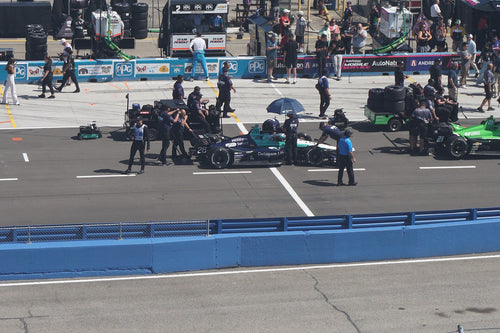
Now you know what you are watching. At a red flag, look for crews shoving fans into the radiator boxes and brake ducts and laying cooling towels over the bodywork. Look for the aeroscreen attendant reaching in to reconnect a hose to the top of a helmet. And when a driver says on the radio that the hybrid is gone, it is usually not broken. It is hot, and somebody bolted one blocker too many behind a radiator.
One more tell: if qualifying is stopped through no fault of a driver's own, the rulebook lets a team make exactly three changes before the car runs again. Change tires, add fuel, and open up the radiator shutters.
The Bottom Line
An IndyCar does not really have a cooling system. It has a cooling budget. Air is the currency, holes in the bodywork are the spending, and speed is what you give up. Every crew spends the weekend trying to run one blocker hotter than the team next door, and the first one to miscount loses sixty horsepower of hybrid for half the race.
Shop the story. If the tech side of IndyCar is your thing, the gear is here.