F1 Wind Tunnel Rules Explained: Why Winners Get Less Testing
Welcome to the Happy Hour Racing Formula 1 Tech Breakdown - one piece of F1 tech, explained in plain English. No engineering degree required.

The Short Version
F1 wind tunnel rules ration how much aerodynamic testing each team gets, and the ration runs backwards: the better you finish, the less you get. The FIA calls it the Aerodynamic Testing Restrictions, and it has worked this way since 2021. The champion team gets 70 percent of a baseline allowance, and the teams at the bottom get up to 115 percent. Mercedes just clinched the 2026 constructors' title in Brazil, which puts them at the front of the line for the smallest share.
Why F1 Teams Need a Wind Tunnel at All
An F1 car lives and dies by air. The floor, the wings and every curve of the bodywork are shaped to push the car into the track so it can carry more speed through corners. We covered how much of that grip comes from underneath in our ground effect breakdown.
Teams find that grip two ways. One is CFD, short for computational fluid dynamics, which is a computer simulation of air flowing over a digital car. The other is the wind tunnel, where a scale model sits on a moving belt while fans blow air over it and sensors measure the forces. Think of CFD as the sketch and the tunnel as the reality check. A new front wing usually lives in both before it ever bolts onto a race car.
Left alone, the richest teams would run their tunnels around the clock. So the FIA puts a cap on both tools.
How the F1 Wind Tunnel Rules Work
Start with the baseline. Over each two-month testing block, the baseline allowance is 320 wind tunnel runs and 2,000 CFD simulations. Nobody actually gets "the baseline." Every team gets a percentage of it, and that percentage depends on where it sits in the constructors' championship.
The team in first gets 70 percent. Each spot down the order adds 5 percent, all the way to 115 percent at the bottom. In real numbers, that is 224 wind tunnel runs for the champion and 368 for the team in last, every two months.
The order is not frozen for a whole year. The scale resets twice a year, so a team that climbs the table in the summer loses some testing time for the second half, and a team that slides gets a boost. The first half of each season is set by the final standings from the year before.
The Limits on the Tunnel Itself
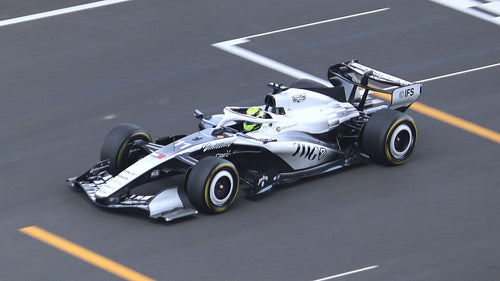
The runs are not the only cap. Teams cannot test a full-size car in the tunnel. Models can be no bigger than 60 percent of a real car, like the Manor model in the photo above, and the air can blow no faster than 50 meters per second, which is about 112 mph. A real F1 car goes far faster than that, so engineers scale the results up.
The FIA polices all of it with audits. Teams keep a log of every wind tunnel and CFD run, and the tunnels carry logging equipment that records when each run starts and stops. That is how the FIA knows a team used 224 runs and not 225.
What It Looked Like in 2026
The first half of 2026 was set by the 2025 standings. McLaren won the 2025 constructors' title, so it opened 2026 on 70 percent, or 224 runs and 1,400 CFD simulations per block. Mercedes, second in 2025, got 75 percent. Red Bull got 80 and Ferrari got 85.
Alpine finished last in 2025 and got the top rate of 115 percent. Cadillac, the new 11th team, also started 2026 on that same top allocation. It was not handed unlimited testing just for being new.
Small moves in the table matter. Haas fell from sixth to eighth in 2025, and that drop earned it 32 more wind tunnel runs and 200 more CFD simulations per block for early 2026. Red Bull, Racing Bulls and Aston Martin each climbed a spot and each lost 16 runs and 100 simulations.
The Price of Winning: Mercedes in 2027
Mercedes clinched the 2026 constructors' championship at Interlagos on November 8 with three races still to run. It is the team's ninth constructors' title and its first since 2021. Here is how F1 announced it.
MERCEDES ARE THE 2026 WORLD CONSTRUCTORS' CHAMPIONS.
- Formula 1 (@F1) November 8, 2026
Back on top for the first time in five years. #F1 #BrazilGP pic.twitter.com/WhKmQIdwlE
The catch is right there in the scale. If it works in 2027 the way it has every year since 2021, Mercedes will open next season on the smallest testing allowance in the sport, while the teams behind them get more runs to catch up. That is the whole idea. The rule does not take speed away from the winner. It gives the chasers more chances to find their own.

When the Testing Allowance Becomes a Penalty
The same system doubles as a punishment. After Red Bull broke the budget cap in 2021, the FIA fined the team 7 million dollars and cut its aerodynamic testing by 10 percent for 12 months. Red Bull had just clinched the 2022 constructors' title and was already on the 70 percent rate, so the penalty stacked on top of the smallest allowance on the grid.
That tells you how much teams value tunnel time. A fine is just money. Losing runs means losing development, and you cannot buy that back.
The Bottom Line
In F1, winning costs you wind tunnel time. The Aerodynamic Testing Restrictions hand the champion the smallest share and the last-place team the biggest, then reset twice a year so nobody stays comfortable. Mercedes earned the 2026 title. Now they get to defend it with the fewest runs in the paddock. For the rest of the season, keep an eye on our Formula 1 schedule and standings.
Gear Up for the Final Three Races

The wind tunnel runs on scale models, so it is only right that the merch does too:
- Mercedes AMG Petronas F1 George Russell 1:2 Scale Helmet - a half-size replica from the 2026 constructors' champions.
- Red Bull Racing F1 Max Verstappen RB16B Dutch GP 1:18 Model Car - a scale model of the 2021 car, the season behind that budget cap penalty.
- McLaren F1 Lifestyle New Era 9Fifty Camo Hat - for the team that started 2026 on the 70 percent rate.
- Men's Formula 1 Tech Collection Team Softshell Jacket - official F1 Tech Collection outerwear.
See the full lineup in our Formula 1 gear collection.