The Happy Hour Racing NASCAR breakdown - the rule that decides more races than any other, explained in plain English.

The Short Version
NASCAR overtime happens when a caution comes out too late for the race to finish under green. Instead of ending it under yellow, NASCAR adds laps and runs a two-lap dash: green, white, checkered. The leader has to make it all the way around to the white flag for the attempt to count. If a caution flies before that, everybody lines up and goes again, as many times as it takes. Once that white flag is out, the next flag ends the race, and that flag can be a yellow.
What Overtime Actually Is
A NASCAR race has a scheduled distance. The Daytona 500 is 200 laps. Bristol is 500. If the race runs clean to the end, that number is the number.
Overtime throws that out. If a caution comes out inside the final two laps, NASCAR is not going to let the race finish behind the pace car. It extends the distance and restarts the field for a two-lap sprint. Green flag, white flag, checkered flag. That is where the old name comes from.
The race is now longer than advertised. Fuel that was going to be enough is not enough. Tires that had two laps left in them now have four or six or ten. That is the part that turns finishes upside down.
The Overtime Line Is the Start-Finish Line
This is the part almost everyone gets wrong, including a lot of pages that come up when you search it.
There is an overtime line. It is the start-finish line. That is it.
For a restart to count as a real overtime attempt, the leader has to take the green, run the full lap, and cross the start-finish line to take the white flag. Get there and the attempt is official. The race is ending, one way or another.
If a caution comes out before the leader gets to the white flag, the attempt does not count. NASCAR resets the field and runs it again.
Why a Race Can End Under Yellow
Once the white flag waves, the rule flips.
From that moment, the next flag NASCAR shows ends the race. If that next flag is the checkered, you get a clean finish. If somebody wrecks on the last lap and the yellow comes out first, the race is over right there, under caution, and the running order is frozen.
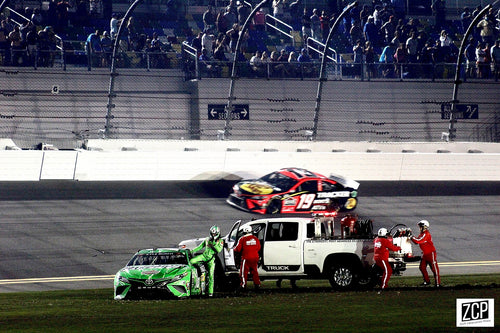
That is why you will see a field come across the line at half speed with the leader already celebrating. The race did not get another attempt because the white flag had already been displayed. It is not NASCAR calling it early. It is the rule doing exactly what it says.

How Many Attempts You Get
Unlimited.
There is no cap. NASCAR will keep resetting the field and trying again until somebody completes that lap to the white flag. If you read somewhere that you get three attempts, that page is running on rules NASCAR stopped using after 2015.
In practice it rarely goes past two or three tries, because the field usually gets strung out enough to make it. But there is nothing in the rule that stops a fourth or a fifth.
How We Got Here
The rule has been rewritten four times, which is a big reason the bad information is still floating around.
2004. NASCAR adopts green-white-checkered across its national series. One attempt. If it did not work, the race was over.
2010. Expanded to three attempts, starting at the Budweiser Shootout.
February 2016. NASCAR invents a separate overtime line, painted partway around the track, usually about halfway through the next-to-last lap. The leader had to reach that line for the attempt to stick. Nobody could see it from the stands and nobody could agree on the calls.
August 2017. NASCAR moves the overtime line back to the start-finish line and drops the attempt limit. That is the rule you are watching today.
There is one more wrinkle added in 2024. If the one-to-go signal comes out right as the time limit is reached, the restart is a single lap instead of two.
What to Watch For
When the caution comes out late, stop watching the leader and start watching the fuel numbers. Crew chiefs who short-pitted for track position are the ones sweating. An extra four laps is the difference between a win and coasting home on fumes in 20th.
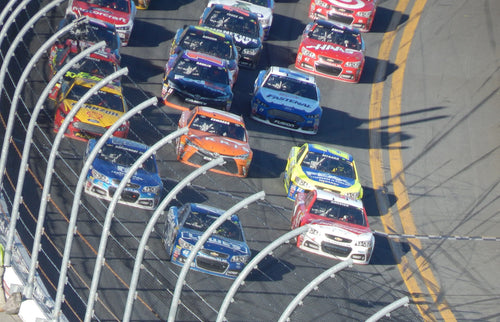
Watch the restart order too. Overtime restarts are double-file, and the driver on the outside of row one has one lap to make a decision. There is no time to fix a bad launch.
Frequently Asked Questions
What is NASCAR overtime?
It is a two-lap extension NASCAR adds when a caution comes out too late to finish the race under green. The field restarts and runs green, white, checkered.
Where is the NASCAR overtime line?
It is the start-finish line. It has been there since August 2017. The leader has to cross it under green to take the white flag for the attempt to count.
How many overtime attempts does NASCAR allow?
Unlimited. The three-attempt limit ended after the 2015 season.
Why did the race end under caution?
Because the leader had already taken the white flag. After the white flag, the next flag ends the race, and that includes a yellow.
Does overtime make the race longer than the scheduled distance?
Yes. The official distance goes up, which is why fuel and tire strategy falls apart in overtime.
The Bottom Line
Overtime comes down to one line and one flag. The leader has to get back to the start-finish line to take the white. Before that, a caution means run it again. After that, a caution means it is over.
Gear Up for the Finish

Overtime is how a lot of these shirts get made. Somebody wins a race nobody saw coming, and the win shirt goes up the same week.
- Winner's Circle Shirt Subscription - the winning driver's shirt, every race, without chasing the drop.
- Chase Briscoe #19 2026 Chicagoland Winner T-Shirt
- Chase Elliott #9 2026 Martinsville 500 Winner T-Shirt
- Brad Keselowski #6 2024 Darlington Winner T-Shirt
More race-win gear is in the race wins collection.