Why F1 Cars Look Different in 2026: The New Wings and Power Units, Explained
Welcome to the Happy Hour Racing Formula 1 Tech Breakdown - the F1 companion to our NASCAR Wednesday Tech series, where we take one confusing piece of race car engineering and make it make sense. No engineering degree required.

The Short Version
For 2026, Formula 1 tore up two of its biggest rulebooks at once. DRS is gone. In its place, every car now has movable front and rear wings that the driver opens on the straights and closes in the corners. At the same time, the engines changed just as much. The old turbo-hybrid V6 is still there, but the electric motor now supplies about half the car's power instead of a fifth, and a whole system called the MGU-H got deleted. More electric power, smarter wings, one goal: closer racing without leaning on a single push-to-pass button. Here's what's actually happening under the bodywork.
The Engine: Half Gas, Half Electric
Every current F1 car runs a 1.6-liter turbocharged V6 paired with a battery and electric motor. That part hasn't changed. What changed is how much power comes from each side. Through 2025, the electric motor - the MGU-K, or Motor Generator Unit-Kinetic - added roughly 120 kilowatts on top of the engine, about 20 percent of the total push. For 2026 the MGU-K got nearly three times stronger, now sending 350 kilowatts straight to the rear wheels. That works out to roughly half the car's power coming from the battery instead of gasoline.
To make room for that jump, F1 deleted the MGU-H, the old system that recovered energy from the turbo's exhaust gases. It worked, but it was expensive and had nothing to do with the hybrid systems in road cars, so cutting it made the power unit cheaper to build - a big reason Audi joined the grid for 2026. Drivers also harvest electric energy earlier now, lifting off the throttle well before a braking zone instead of waiting for hard braking, so the battery has more to spend later in the lap.
No More DRS: Meet X-Mode and Z-Mode
DRS, the flap on the rear wing that opened for overtaking, is retired for 2026. It's been replaced by something bigger: active aerodynamics, where both the front wing and the rear wing physically change shape all lap long, not just for one car chasing another.
There are two states. Z-Mode is the default. The wing flaps sit closed and angled, shoving the car down into the track for maximum grip in the corners. X-Mode is the low-drag setting. On a long enough straight, the driver presses a button, the flap conditions have to be met first (the car has to be running straight, not still turning out of a corner), and both wings flatten out to cut through the air with less resistance. Right before the next braking zone, the driver switches back, or the car's electronics force it back automatically so the driver has full grip for the corner. FIA single-seater technical director Jan Monchaux described it plainly: the driver presses the button, "it's not going to be automated."
The biggest difference from the DRS era: everyone gets to run low-drag mode on the straights, not just a car within one second of the driver ahead. That means the overtaking edge doesn't come from wing angle anymore. It comes from who managed their electric energy better and has more of it left to spend.
Here's how will #F1's 2026 active aero work 🤓
— Autosport (@autosport) June 11, 2024
It appears drivers will be able to switch between X-Mode for the straights and Z-Mode for the corners, with movable elements of the front and rear wings changing the downforce and drag levels to suit. pic.twitter.com/u3VLkLaHKr
Why It Mattered Early This Season
The new rules didn't roll out perfectly. In the first few races, cars carrying different amounts of stored electric energy closed on each other far faster than drivers expected, because a car with a big electric boost saved up could suddenly surge past one that had just spent its charge. The scariest example came at the Japanese Grand Prix, where Oliver Bearman had to take evasive action at 308 km/h after the closing speed to a slower car jumped without warning. His Haas hit the barrier at 50G. He was checked out and cleared, but the crash pushed the FIA into emergency meetings.
The fixes that followed capped how much electric boost a car can deploy at once, added warning lights so a trailing driver can see when the car ahead is about to surge, and reset each car's energy count at the start of a formation lap. Even a rulebook this carefully engineered needed real laps, and a real scare, before it settled in.

What You'll See on Track
Watch a car's rear wing on the front straight this week. Flat and closed up, that's X-Mode, chasing top speed. Snapping back open under braking, that's Z-Mode returning for grip into the corner. Listen for commentators talking about a driver "saving energy" instead of "hitting DRS." That's the new currency of overtaking. And if a car suddenly rockets past another on a straight with no warning, that's the closing-speed issue the FIA spent the spring trying to tame.
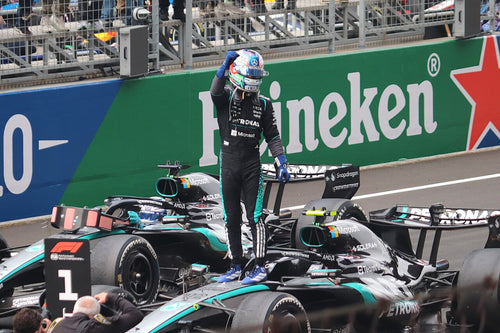
The championship has been a showcase for the new power unit so far. Mercedes has been the strongest team of 2026's opening stretch, with Andrea Kimi Antonelli leading the drivers' standings and George Russell winning the Austrian Grand Prix at the Red Bull Ring. That's the new hybrid system doing exactly what it was built to do: reward the team that manages the electric side of the car best, lap after lap.
The Bottom Line
2026 boils down to one trade: F1 swapped a single overtaking button for a whole new set of decisions the driver has to make every lap. More electric power, wings that change shape instead of a fixed rear flap, and an energy budget to manage from the green flag to the checkered one. It's more complicated to explain, but once you know what X-Mode, Z-Mode, and the MGU-K actually are, the racing gets a lot easier to read.

Mercedes has been the team to beat early in 2026. Grab the Mercedes-AMG Petronas ball cap above or browse the full F1 hats collection for more gear. New tech breakdowns drop every week - bookmark the blog and never get lost in the jargon again.