Why Every IndyCar Has a Windshield Now: The Aeroscreen, Explained
Welcome to the Happy Hour Racing IndyCar Tech Breakdown - where we take one confusing part of open-wheel racing and make it make sense. No engineering degree required.

The Short Version
An IndyCar used to be a completely open cockpit. No roof, no windshield, nothing between the driver's head and whatever came flying at it. Since 2020, every car runs the aeroscreen, a curved windshield backed by a titanium frame that wraps around the driver. It was built after a piece of debris killed driver Justin Wilson in 2015, and it has already stopped flying wheels, wrecked cars, and even a bird strike from reaching a driver's helmet. Here is how it works and why it looks the way it does.
Why This Even Exists
For decades, IndyCar's answer to head protection was a helmet and hope. That changed after August 23, 2015, at Pocono Raceway. Sage Karam crashed and the nose cone of his car broke off. It struck Justin Wilson in the head as he came through at speed. Wilson died from his injuries the next day. He remains the last driver to die in an IndyCar race.
Wilson's death pushed IndyCar to get serious about cockpit protection. The series announced a partnership with Red Bull Advanced Technologies, the same group that builds Formula 1 cars, in May 2019. Instead of copying F1's halo, which is just an open titanium bar, IndyCar went further and built a full windshield to go with it. That combination, screen plus frame, is the aeroscreen. It went through crash and debris testing in late 2019 and became mandatory on every car, every track type, starting with the 2020 season.
Meet the Two Parts That Matter
The frame is titanium, shaped like a wraparound roll bar, and bolted directly into the chassis around the cockpit opening. It is rated to take roughly 34,000 pounds of force, about 17 tons, without giving way. That is the part that has to survive a car landing upside down or getting hit by another car's suspension piece.
The screen is the actual windshield: a laminated, ballistic-rated polycarbonate panel made by PPG, the same company that makes aircraft canopy materials. It is built to stop a 2-pound object hitting it at more than 220 miles per hour without letting it through. Drivers stick a stack of thin tear-off layers on top of it, three or four per race, and peel one off when it gets covered in rubber marbles or bugs, the same idea as tear-offs on a helmet visor.
Neither piece works alone. The frame gives the screen something rigid to sit on, and the screen's curved shape is what actually redirects an incoming object up and away from the driver's helmet instead of catching it flat.
The aeroscreen's value is not theoretical. Here is a real example, straight from IndyCar's own broadcast partner, of what it looks like when the design does its job:
Both Josef Newgarden and Louis Foster are okay after this scary wreck at WWT Raceway. pic.twitter.com/s2OhHPEWib
— INDYCAR on FOX (@IndyCarOnFOX) June 16, 2025
What Changed for 2024
The first aeroscreen worked, but it was heavy, and heavy weight sitting up high on a race car hurts handling. For the 2024 season, debuting at the Acura Grand Prix of Long Beach, IndyCar and its partners rolled out a lighter version without giving up any strength.
Engineers thinned the screen from 9mm to 6mm and dropped its built-in heating element, which used to keep it from fogging up. The new 3D-printed titanium frame uses a "topology optimized" shape, meaning material only sits where the load actually needs it, like the branching structure of a bone. The result carries the same rated strength in a lighter package. The redesign also added air vents and a duct that blows straight onto the driver's chest, because cockpit temperatures during a race can push past 100 degrees and heart rates run at 85 to 95 percent of max. The new venting duct is 3D-printed in rubber instead of hard plastic, specifically so a driver's hand does not get hurt on it during a crash.
What You Will Actually See on Track
Watch for it during any big incident. When a car goes airborne or spins into traffic, the broadcast will usually cut to a replay showing debris skipping off the aeroscreen instead of into the cockpit. That is not an accident. It is the curved screen doing exactly what it was designed to do.

It already has a track record. At Barber Motorsports Park in April 2021, Josef Newgarden's car went airborne on the opening lap and a wheel flew directly over Ryan Hunter-Reay's car, deflecting off the aeroscreen. Hunter-Reay said afterward the aeroscreen "likely saved my life." In June 2025 at World Wide Technology Raceway, Newgarden crashed again, this time landing upside down, and both he and Louis Foster, whose own aeroscreen deflected a hail of debris in the same incident, walked away. Since the aeroscreen became mandatory in 2020, IndyCar has not lost a driver in a race.
The Bottom Line
The aeroscreen is not a decoration and it is not a fairing. It is a titanium roll cage and a bulletproof windshield working together, built because a driver died and the series decided that could not happen the same way again. Every time you see an IndyCar go by, that curved screen in front of the cockpit is doing its job quietly, race after race.

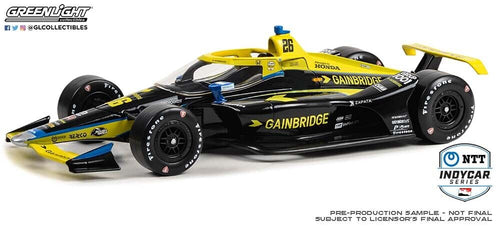
Following IndyCar and want gear that actually looks like it belongs at the track? Check out the Indy 500 car flag tee, the 109th Running snapback hat, or the Colton Herta #26 1:18 diecast. Or browse the full IndyCar collection. New tech breakdowns drop every week, bookmark the blog and never get lost in the jargon again.