Why 0.4 MPH Can Cost You a Lap: How NASCAR Actually Catches Pit Road Speeding
Welcome to the Happy Hour Racing Wednesday Tech Breakdown - where we take one confusing part of NASCAR and make it make sense. No engineering degree required.

The Short Version
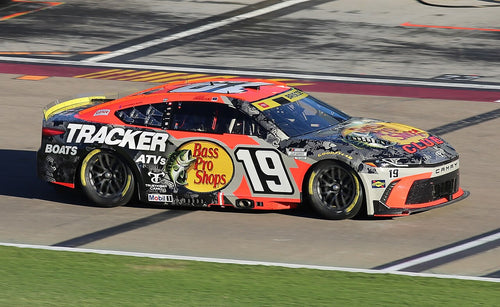
NASCAR does not catch pit road speeding with a radar gun. It uses wire loops buried in the pavement, a transponder in every car, and simple math: distance divided by time. There is no such thing as an instant speed reading on pit road, only an average over a stretch of track, and that stretch can be as short as 80 feet. Drivers get a small cushion over the posted limit, but once they cross it, the penalty is automatic. Chase Briscoe found that out at Las Vegas this year when he was caught going just 0.4 mph too fast.
Why Pit Road Even Has a Speed Limit
On the track, cars run 150 to 200 mph with nobody standing next to them. On pit road, a car is surrounded by crew members on foot, carrying tires, fuel cans, and jacks, with almost no protection between them and 3,400 pounds of race car. That is why every track posts a pit road speed limit, usually somewhere between 35 and 55 mph. Atlanta is the oddball: cars can run 90 mph down the long pit entrance before dropping to 45 mph once they reach the actual pit boxes. The limit is not about lap time. It is a safety number, and NASCAR treats going over it like running a red light. There is no partial credit.
How the Clock Actually Catches You
Here is the part most fans get wrong: NASCAR is not clocking a car's speed at any single point on pit road. It is measuring how long a car takes to travel between two fixed lines, then doing the math. Speed equals distance divided by time. If a segment of pit road is 200 feet long and a car covers it in 2.5 seconds, officials know its average speed for that stretch, down to a fraction of a mph.
That word "average" matters. A driver could stab the gas hard right after leaving their pit box and let off before the next line, and as long as the average stays under the limit, no penalty gets called. It also means a driver can be legal on one segment of pit road and speeding on the very next one, because pit road is chopped into several timed segments, not just one long one.
Meet the Parts: Transponders, Loops, and the Tolerance
The transponder is a small unit mounted inside each car that sends out a short-range signal, like an E-ZPass checking in at every loop it passes.
The scoring loops are wire loops buried about a foot under the asphalt, spaced out across pit road. Teams get an actual map of exactly where each loop sits, so crew chiefs know precisely which stretch is being timed at any moment.
The tolerance is the small cushion built into the system to account for measurement noise, commonly cited as around 5 mph over the posted limit. That sounds generous until a driver realizes it is a hard line, not a soft one. Go 0.1 mph past the effective limit and the penalty is the same as going 10 mph past it. There is no partial violation on pit road.
Bob Pockrass, who covers NASCAR for FOX Sports, posts these calls almost as soon as they happen:
Logano and Berry speeding on pit road. Pass-throughs.
— Bob Pockrass (@bobpockrass) via X
What the Penalty Actually Costs You
Once NASCAR flags a violation, the crew chief hears about it on the radio almost immediately, and which penalty gets applied depends on when the speeding happened and how the race is running at that moment.
The mildest version is a pass-through, where the car drives the length of pit road at the legal speed without stopping for service. Worse is a stop-and-go, where the car has to stop in its own pit box first and then still serve the drive-through. The harshest outcome is getting sent to the tail end of the field or losing a lap outright, which is what nearly happened to Chase Briscoe at the Pennzoil 400 in Las Vegas this year. He was caught just 0.4 mph over the limit on lap 32, went a lap down, and only got back onto the lead lap when a caution handed him the free pass. He still fought back to finish eighth, but a fraction of a mph almost cost him the whole afternoon.

Why This Matters More in 2026
We covered a few weeks back how five more tracks picked up the low-downforce, higher-horsepower package for 2026, which makes cars slide more off the corners. That same precision problem shows up the second a car turns onto pit road, because a car that is already fighting for grip has to shed speed fast enough to be legal at the first loop. Pit road speeding has been a weekly storyline all season, from Briscoe's near disaster at Las Vegas in March to multiple cars getting caught at Chicagoland just this month. The margin for error has not gotten any bigger.
What You Will See on Track
Watch for the pit road lights at pit-in and pit-out, they mark where the timed zone begins and ends. Listen to race broadcasts for a spotter or a scanner feed calling out "you're a little hot" as a car comes off pit road, because crews are watching their own numbers in real time. And if you see a car suddenly go from battling for the lead to running laps down with no wreck involved, check the scoring pylon or the broadcast graphic. Nine times out of ten, somebody got caught by a loop in the pavement they never saw.
The Bottom Line
Pit road speeding is not decided by a cop with a radar gun watching one spot. It is decided by two hidden lines in the pavement and simple math, which means the margin for a mistake is smaller than most fans realize, sometimes smaller than half a mile per hour.

The crew chief is the one hearing about a speeding call before you even see it on the broadcast graphic. Rep the guys who live and die by that radio call with our full driver and team collections. New tech breakdowns drop every Wednesday - bookmark the blog and never get lost in the jargon again.