What Is the F1 Halo? The Titanium Ring That Saves Lives
Welcome to the Happy Hour Racing Formula 1 Tech Breakdown - where we take one confusing part of F1 and make it make sense. No engineering degree required.

The Short Version
The halo is the curved bar that sits above an F1 driver's head. It is made of aerospace-grade titanium, weighs about 9 kilograms, and bolts to the car at just three points. The rules require it to hold roughly 14 tonnes without the car breaking around it. Fans hated it on sight in 2018. Eight years later it has been credited with saving at least four drivers, and nobody is arguing about how it looks anymore.
Why F1 Put a Ring Over the Cockpit
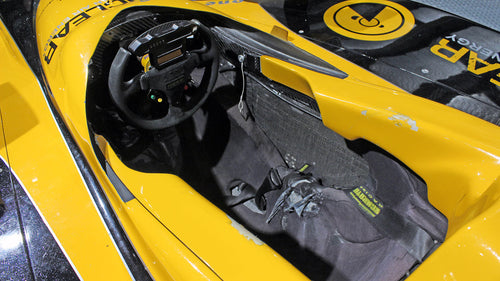
An open-cockpit car has an obvious problem: the driver's head is the highest, softest thing on it. A run of head injuries in open-wheel racing forced the FIA to admit that a helmet alone is not enough when a loose wheel or another car arrives from above.
The FIA tried the pretty option first. It was called the Shield, a clear curved screen ahead of the cockpit. Sebastian Vettel ran it in practice at the 2017 British Grand Prix, said it distorted his vision, and that was the end of that. The halo was the ugly option that worked, so it became mandatory in 2018 across F1, F2, F3, F4 and Formula E.
The reaction was brutal. Drivers, team bosses and fans called it a flip-flop, a thong, a disfigurement. The FIA pushed it through anyway, because it had run the numbers: simulations across 40 real incidents found the halo raised a driver's survival rate by 17 percent.
Meet the Parts
The halo is simpler than it looks. There are only three pieces that matter.
The main hoop is the big curved bar that arcs over and around the driver's head. This is the part that takes the hit.
The centre pylon is the single vertical post in front of the driver's face. It sits close enough that the brain edits it out the same way you ignore your own nose. Drivers say they stop noticing it within a lap.
The three mounts are where it bolts to the survival cell, the carbon fibre tub the driver sits in. One at the front under the pylon, two at the back. That is it. Three bolted joints carry everything.

The Test It Has to Pass
This is where the halo stops being a bar and starts being an engineering problem. The FIA does not simply ask that the halo survive. It asks that the car around it survive.
Open the 2026 Formula 1 Technical Regulations and the halo is not even called the halo. It is the Secondary Roll Structure, Article 12.4.2. The test rules are blunt: the FIA pushes about 130 kilonewtons straight down plus another 52 shoving it backwards, all at once, and holds it there for five seconds. Then it repeats the exercise from the side. Both tests run to a load of 140 kilonewtons.
A kilonewton is just a unit of force. 140 of them is roughly 14 tonnes, about 31,000 pounds. Mercedes technical director James Allison put it in human terms while developing the concept, saying they had to strengthen the chassis to take "roughly the weight of a London double decker bus sitting on top of the halo."
And here is the part that matters: after those five seconds there must be no failure of the survival cell or of any attachment. Not the halo. The tub. A halo that holds while tearing a hole in the car would be worthless, so the rule tests the whole joint.
Every Team Runs the Exact Same Halo
Here is the detail most fans do not know. In a sport where teams spend fortunes chasing a tenth of a second, the halo is one of the very few parts nobody is allowed to touch.
The regulations say it must be built to a standard called FIA8869-2018 and supplied by an FIA designated manufacturer. Only a small number of firms are approved to make them. The FIA even states that it will take measures to ensure halos from different manufacturers are of similar mass, so no team gains an advantage from a lighter one.
Red Bull cannot build a trick halo. Ferrari cannot shave grams off it. Every car on the grid carries the same certified ring, made from Grade 5 titanium, heat treated, welded in a sealed chamber, then x-rayed and crack tested before it goes near a car. Teams may only add a thin aerodynamic fairing over it, which is why halos look slightly different car to car while the structure underneath is identical.
What It Has Already Done
The argument ended on track, not in a meeting.
At Spa in 2018, Fernando Alonso's McLaren was launched over Charles Leclerc's Sauber, leaving tyre marks on the halo directly above where Leclerc's helmet had been. At Bahrain in 2020, Romain Grosjean's car speared through a barrier and caught fire, and the halo parted the steel rail his head was heading for. Grosjean had been one of the loudest critics. Afterwards he called it the greatest thing F1 ever brought in, and said that without it he would not have been able to speak.
At Monza in 2021, Max Verstappen's Red Bull came down on top of Lewis Hamilton's Mercedes and a rear tyre landed on the halo. Hamilton walked away with a sore neck and said the halo saved it.
Then Silverstone 2022, the one that settled it. Zhou Guanyu's car flipped upside down, skated across the gravel on the halo, and went over the tyre barrier into the fencing. His roll hoop, the structure behind his head, broke. The halo did not. Zhou climbed out and posted this hours later.
I'm ok, all clear. Halo saved me today. Thanks everyone for your kind messages! pic.twitter.com/OylxoJC4M0
— 周冠宇 | Zhou Guanyu (@ZhouGuanyu24) July 3, 2022
What You Will See On Track
Now that you know what it is, watch for it. When two cars touch wheels and one climbs the other, watch the replay and look at what the tyre lands on. It is almost never the helmet anymore.
And watch the drivers get out. That gap between the pylon and the hoop is the hole they climb through, and the rules still require a driver to be out of the car in seven seconds with the halo fitted.
The Bottom Line
The halo is 9 kilograms of titanium doing the single most important job on the car. It is the ugliest thing F1 ever bolted on, and it is the best decision the sport has made in 30 years. Every fan who complained about it in 2018 has since watched it work, more than once.
Fly the Formula 1 Colors

If reading this made you appreciate the engineering a little more, we have the gear to match. A few in stock right now:
- Formula 1 Tech Limited Edition Belgian GP Hat, White
- McLaren F1 Lifestyle New Era 9Fifty Camo Baseball Hat
- New Era Renault F1 Alpine MX 9Fifty Adjustable Cap, White
- Alfa Romeo Racing F1 Limited Edition Reversible Bucket Hat, Black
Plenty more in the Formula 1 collection.